Living with AGI in 2030: How Everything Changed

ARTIFICIAL GENERAL INTELLIGENCE (AGI) REVOLUTION

An imaginary future

Image created by ChatGPT

I never thought I’d see the day. Artificial General Intelligence — or AGI as everyone calls it — is now part of everyday life. Back in the 2020s, it felt like something out of a movie.

You’d hear tech people throw around terms like “superintelligence,” and I’d nod along, not understanding.

But now? I’m living it.

And let me tell you, it’s not what I expected — it’s better.

“AGI? What’s That?”

I still remember the first time I heard about AGI hitting the scene.

It was all over the news: “AGI has arrived!” My first thought? Here we go, another overhyped tech buzzword.

It was just another fancy update to those voice assistants who could barely understand me half the time.

But then, over the next few weeks, things started to change—real change.

Hospitals began announcing breakthroughs, governments were talking about smarter cities, and my neighbours were raving about how AGI was making their lives easier.

Mornings Made Simple

Fast forward to today, and AGI is part of my daily routine.

Every morning, my assistant, let’s call it “Genie,” greets me like a friend who knows me a little too well.

Good morning, Mazlan! You didn’t sleep well last night — should I push your 9 a.m. meeting to the afternoon?

I blink at my screen, barely awake. How does it know? Then I glance at my smartwatch, which has been tracking my sleep patterns.

Of course, Genie knows. It’s connected to everything — my watch, calendar, even the temperature of my bedroom.

Yes, please,” I mumble, still groggy.

Genie’s not just a glorified organiser. It gets me.

If I’m feeling stressed, it suggests a quick meditation.

If I’m on a productivity streak, it lines up tasks so I can breeze through them.

It’s like having a personal assistant, life coach, and best friend rolled into one.

“Wait, My Health Is in Check?”

The biggest game-changer for me has been healthcare.

I’ve always been terrible about going to the doctor.

Who has the time? But now, I don’t need to. Genie monitors everything — heart rate, blood pressure, you name it.

Last year, it flagged something unusual with my heartbeat. “It’s probably nothing,” I thought, but Genie insisted I schedule a virtual check-up.

It turns out it wasn’t anything. The doctor said it could’ve turned into something serious if we hadn’t caught it early.

It’s weird, isn’t it? A piece of tech cared about my health more than I did.

And now, I don’t take it for granted. Knowing Genie’s got my back — even for things I can’t see — makes me feel safer.

My Kids Are Thriving

The way my kids learn now blows my mind. Back in school, it was all about memorising facts and fitting them into one-size-fits-all lessons.

But for my kids? AGI creates lessons tailored to them.

My youngest is obsessed with space. She’s learning everything from the physics of black holes to the history of space exploration—all in exciting ways.

The other day, she asked me, “Dad, did you know a black hole can ‘spaghettify’ a star?

Uh, sure,” I said, pretending to know what she was talking about. But inside, I was amazed. She’s learning things I didn’t even know existed at her age and loving it.

Cities That Work for Us

Even the city feels different now.

Remember those awful traffic jams? Gone. AGI manages the flow of self-driving cars so perfectly that I haven’t been stuck in traffic in years.

Buses, trains, even bikes — all move like clockwork.

And energy? Thanks to AGI’s smart grids, my house runs entirely on renewable power. I don’t even think about electricity bills anymore.

Genie ensures everything is efficient.

One day, I asked, “Why haven’t we had a blackout in years?

Genie replied, “Because every kilowatt of energy is optimised, Mazlan.

I didn’t fully understand the science, but I got the point: AGI handles things so well that I don’t have to worry about them.

Rediscovering What Matters

Here’s the surprising part: I’ve rediscovered things I’d forgotten about with AGI taking care of so much.

Like playing my guitar, I used to love strumming Bee Gees songs, but life got in the way. Now, I have time to pick it up again.

And it’s not just me.

My neighbour, a retired engineer, has started painting landscapes. Another friend is finally writing the book he’s been talking about for years. It’s like we’ve all been permitted to dream again.

Not Everything’s Perfect

Of course, not everything about AGI is sunshine and rainbows.

Some people are still trying to figure out who controls it. “What if it gets misused?” they ask. It’s a valid question.

I’ve even joined a few local forums to discuss how AGI should be managed.

Do you think AGI could ever take over?” I asked a tech-savvy friend recently.

Only if we let it,” he replied. “That’s why we need to stay involved.

It’s reassuring to know that while AGI is brilliant, the big decisions still rest with us.

Looking Ahead

As I sit here, writing this on my porch, I can’t help but feel grateful. AGI hasn’t just made life easier — it’s reminded us what it means to be human.

We’re no longer drowning in mundane tasks or endless stress. We have real-time time to connect, create, and enjoy life.

Life in 2030 isn’t perfect, but it feels like a step in the right direction.

For the first time in a long time, I’m excited about what’s next. And that is the greatest gift AGI has given us: hope for the future.


The Crucial Role of Inclusiveness in AI

AI ETHICS

Principle of AI — Inclusiveness

Image create using ChatGPT

I was fascinated by AI’s potential. It seemed like the future, with endless possibilities to revolutionize healthcare, education, and legal systems.

But one thought kept nagging at me: Who benefits from this technology? It dawned on me that if AI only serves a select group, it could widen existing social inequalities. If AI is only built for those with the most access, are we moving forward?

My work with the Internet of Things (IoT) and smart cities has already shown me how technology, while promising to enhance urban living, often caters to those with the resources to use it.

That same realization hit me with AI: AI must be inclusive.

It has to serve everyone, especially the vulnerable, or we risk creating deeper societal divisions. This is why AI must align with the principles of our Federal Constitution, which emphasizes equality, justice, and fairness for all.

Building Inclusiveness into AI Development

The first step to creating inclusive AI is ensuring the systems are designed for everyone, not just the privileged few.

I remember discussing this with a colleague. I asked, “What happens when AI systems in healthcare only use data from urban hospitals that serve wealthier patients?”

We both knew the answer.

Those systems wouldn’t be effective in rural areas, where diseases manifest differently and healthcare resources are more limited.

This example stayed with me. Imagine an AI designed to detect skin cancer, I thought. If it’s only trained on images of light-skinned individuals, what happens when it’s used on darker-skinned patients?

The answer is obvious: it could misdiagnose or fail to identify the condition entirely. Such bias has serious consequences—it could lead to poorer healthcare outcomes for large sections of the population.

That’s why AI systems need diverse data. We can ensure that AI serves everyone equally by training models on datasets that include various skin tones, environments, and lifestyles.

I remember thinking, This is more than just good design — it’s about justice. AI has to reflect the diversity of the people it’s meant to serve, or we’re not living up to our national values of fairness and equality.

Addressing the Needs of Vulnerable Groups

Then, there’s the issue of how AI tools can meet the specific needs of vulnerable populations.

AI should be for more than just those who live in developed, well-connected areas or who can afford the latest technology. It must serve everyone, especially those in need.

One day, I was thinking about the legal system and how difficult it is for many people to get proper legal representation.

I thought, “What if an AI could provide essential legal advice to those who can’t afford a lawyer?” This idea felt like a breakthrough. AI could help people understand their legal rights, assist in drafting contracts, or even generate legal documents.

But then another thought came to mind: What about people who struggle with reading? Or those without reliable internet access?

For AI to be inclusive, it must account for these users.

I imagined an AI legal assistant offering voice guidance for people with lower literacy levels or an AI working offline to reach remote areas. It became clear to me that AI could be the key to equal access to justice—but only if it’s designed to include everyone.

This aligns perfectly with our national principles of fairness and equality.

Ensuring Diversity Among AI Developers

As much as inclusiveness is about the technology itself, it’s also about who is building it. A diverse team of developers brings different perspectives, helping identify and address biases early on.

Are the people building this AI as diverse as those it serves?

Education is a perfect example of how a lack of diversity in AI development can lead to unintended consequences.

I once discussed AI-powered systems for grading student essays. I wondered, “What if the AI is biased towards a specific cultural or linguistic group?

Imagine a system that unintentionally favors students from urban areas who are more familiar with specific cultural references. Students from rural or minority backgrounds could be unfairly marked down simply because the AI doesn’t understand their context.

That’s where a diverse team of developers comes in.

They would bring a broader range of experiences and insights, helping to design AI systems that are fairer and more inclusive.

I pictured a scenario where developers from various backgrounds are involved in creating an AI-powered educational tool. A diverse team would recognize that not all students have the same internet access, so they design the system to work offline or in low-bandwidth environments.

That’s how AI can truly level the playing field for students, I thought. It’s about giving every student an equal chance, no matter where they come from.

Moving Forward with Inclusive AI

As I reflect on the future of AI, one thing becomes clear to me: Inclusiveness is not a choice; it’s a necessity.

If we’re not careful, AI could widen the gaps we want it to close.

That’s why we need to ensure that AI development techniques are inclusive, tools are designed to meet the needs of vulnerable groups, and that teams behind these systems are as diverse as the society they serve.

In my work with IoT and smart cities, I’ve always aimed to make technology accessible to as many people as possible.

The same approach must be taken with AI.

By focusing on inclusiveness, we can ensure AI systems benefit everyone, which aligns with our Federal Constitution and National Principles. This isn’t just about technology; it’s about creating a fairer, more just world.

In the end, I realized that inclusiveness in AI isn’t a luxury—it’s essential.

If we don’t take inclusiveness seriously, we risk creating technology that serves only the privileged and leaves the rest behind.

And that’s not the future I want to build.

About Favoriot — Part 20: How the Law of Attraction Brought The Startup to Life

FAVORIOT’S JOURNEY

Law of Attraction

Sitting in my quiet office one evening, I glanced at the stack of notebooks on my desk.

Each was a piece of my journey that led to the creation of FAVORIOT. I leaned back in my chair and thought about how it all began.

How did this dream, once a fleeting idea, become a company now empowering the IoT world?

I realised it wasn’t just the hard work or expertise but the belief. It was the Law of Attraction.

Planting the Seed of Belief

Years ago, I questioned my purpose before FAVORIOT was even an idea.

I have worked in corporate environments, government agencies, and universities. Each role taught me valuable lessons, but something was missing — a sense of fulfilment, the feeling of building something from scratch.

While reading about entrepreneurs who transformed their dreams into reality one evening, a question struck me.

What if I could build something that truly impacts the world?” I asked myself aloud.

The thought lingered in my mind. I started visualising it.

I pictured a company that would simplify IoT for businesses, a platform that would bring value to the community, and a name that resonated with our mission.

This was the moment FAVORIOT was born — not in reality, but in my mind.

Turning Visualisation into Reality

The Law of Attraction isn’t magic; it requires action.

I knew that merely dreaming about FAVORIOT wouldn’t bring it to life.

But I also knew that every action begins with a belief.

I began writing down ideas, sketching business models, listing potential collaborators, and jotting down challenges I might face.

Can I do this?” I often asked myself, doubting my abilities.

But each time doubt crept in, I countered it with positivity. “Yes, you can. You have the knowledge, the experience, and most importantly, the passion.

I repeated these words to myself every day, like a mantra.

The more I believed in FAVORIOT, the more the universe seemed to conspire to make it happen.

Attracting the Right People and Opportunities

As I started laying the groundwork for FAVORIOT, I noticed something remarkable.

Opportunities began presenting themselves, almost as if they were drawn to my vision. I met people who believed in my idea.

Some became mentors, others collaborators.

Why do these connections feel so effortless?” I asked myself during one of our early meetings.

The answer was clear: my energy was aligning with my goals.

By focusing on what I wanted to achieve, I attracted individuals and circumstances that supported my mission.

It wasn’t a coincidence; it was clarity.

When your vision is sharp, and your belief is unwavering, the right resources find their way to you.

Overcoming Challenges with Positivity

Building FAVORIOT wasn’t without its challenges.

There were days when nothing seemed to go right — delays in development, scepticism from potential partners, and financial hurdles.

On one particularly tough day, I remember sitting at my desk, staring at a rejection email.

Maybe this isn’t meant to be,” I muttered, feeling the weight of the journey.

But deep down, I knew I couldn’t give up.

I closed my eyes and revisited my vision.

I imagined FAVORIOT thriving, helping businesses, and making an impact. That mental image reignited my determination.

This is just a small setback,” I told myself. “The universe is testing your resolve.

True enough, solutions appeared.

A new client came on board, or a delayed project found momentum.

Each challenge reinforced my belief in the Law of Attraction.

It wasn’t about avoiding problems but maintaining a positive outlook to find solutions.

Celebrating Small Wins

One of the most important lessons I’ve learned is to celebrate every milestone, no matter how small.

The first time FAVORIOT onboarded a customer, I remember smiling to myself.

This is just the beginning,” I said, excited and grateful.

Each achievement was proof that the vision I had nurtured was taking shape.

Gratitude played a considerable role in this journey.

Every morning, I took a moment to thank God—not just for the successes but also for the challenges.

They shaped me, strengthened my resolve, and brought FAVORIOT closer to its purpose.

Manifesting the Future

Today, as I look at FAVORIOT, I see more than just a company.

I see a dream realised.

I know the power of belief, visualisation, and action.

The Law of Attraction isn’t just about thinking positively; it’s about aligning your thoughts, actions, and energy toward your goals.

It’s about turning abstract ideas into tangible outcomes through focus and persistence.

Where will FAVORIOT go from here?” I often ask myself.

The answer lies in the same principles that brought us this far.

I continue to visualise our growth, the impact we’ll create, and the lives we’ll touch.

The journey is ongoing, and the Law of Attraction remains my guide.

As I close my notebook for the day, I feel grateful.

FAVORIOT is more than a business; it’s a testament to the power of belief.

If there’s one thing I’ve learned, it’s this: when you align your thoughts, actions, and energy, the universe listens. And when the universe hears, anything is possible.

About Favoriot — Part-19: The Power of Imagination

Visualising Favoriot’s Bright Future

Imagination is often dismissed as a whimsical exercise, yet it’s the spark that ignites progress.

Reflecting on Favoriot’s journey, I realise how important it is to dream about the future we want to create.

Let me take you on a journey through an imagined future where Favoriot’s influence has transcended borders, industries, and expectations.

The IoT Trade Exhibition of Tomorrow

I picture myself walking into a grand IoT Trade Exhibition — something akin to the CES or the World Smart City Expo, but this time, it feels different.

The atmosphere buzzes with innovation, and as I navigate through the aisles, one thing becomes glaringly apparent: the Favoriot logo is everywhere. Booth after booth, exhibitors proudly display their demos powered by the Favoriot IoT platform.

Startups with groundbreaking hardware solutions, companies showcasing futuristic smart city concepts, and even AI-driven IoT applications — all are connected seamlessly through Favoriot.

It’s not just about data collection anymore; it’s about transforming that data into meaningful actions. Seeing this unfold in real-time, I feel an overwhelming sense of pride.

The exhibitors didn’t just choose Favoriot because it’s a platform; they chose it because it has become a trusted backbone for innovation, a name synonymous with reliability and scalability.

I imagine attendees — business leaders, developers, and students — crowding around these booths, asking how the integration works, marvelling at the ease of deployment, and realising the potential it unlocks for their projects.

I dreamt of this when we first built Favoriot: a world where our platform would be the silent enabler of extraordinary solutions.

Universities as IoT Powerhouses

My next stop in this imagined world is a university. Favoriot has become a standard name here—not just a tool but a part of the curriculum.

In lecture halls, professors discuss real-world IoT case studies, and students dive deep into hands-on learning, exploring the potential of IoT using the Favoriot platform.

I peeked into a lab where students were building their final-year projects. A team was working on a smart agriculture solution, leveraging Favoriot to monitor soil conditions and automate irrigation.

Another group is focused on smart health, creating wearable devices for chronic disease management.

They’re using Favoriot’s analytics features to visualise patient data.

It’s exhilarating to see how a tool we created has become the foundation for nurturing the next generation of IoT innovators.

Universities nationwide and even internationally now teach IoT through Favoriot.

IoT labs are equipped with pre-configured dashboards, APIs, and datasets, making it easy for students to start building.

What was once a platform we envisioned for businesses has become an educational cornerstone. Students graduate not only with degrees but also as skilled Favoriot-certified IoT professionals.

Local Councils and Smart Cities

As I step into a local council’s command centre, I see a vibrant dashboard powered by Favoriot.

The screen displays real-time data from various IoT solutions deployed throughout the city: smart streetlights, waste management sensors, flood detection systems, and air quality monitors.

This isn’t just a piecemeal solution; it’s an integrated system that combines everything under one roof.

The mayor stands by, explaining how this has revolutionised the council’s operations. “Favoriot has helped us move from reactive to proactive,” she says. “We no longer wait for complaints; we solve problems before they arise.”

This is what I imagined when we spoke about smart cities years ago—a city where data drives decision-making, not just to improve efficiency but to genuinely enhance the quality of life for its citizens.

Favoriot isn’t just another vendor in this ecosystem—it’s the platform local councils trust to aggregate and analyse IoT data, bridging the gap between diverse solutions and actionable insights.

IoT Product Houses and System Integrators

IoT product companies no longer struggle to create end-to-end solutions in this envisioned future.

Instead, they focus on what they do best — building world-class hardware or cutting-edge AI applications.

Favoriot fills the gap by providing a ready-made, robust platform to manage data collection and analysis.

Imagine a company specialising in healthcare sensors. Instead of spending years developing its own platform, it uses Favoriot to connect its devices.

This shortens its time-to-market, and its customers benefit from a complete solution that’s both scalable and user-friendly.

The same goes for system integrators, who rely on Favoriot to simplify IoT deployments for their clients.

System integrators have taken this even further by offering managed IoT services.

With Favoriot, they can provide their clients with dashboards, analytics, and customised solutions without the technical headache of building everything from scratch.

It’s a win-win: the integrators expand their business offerings, and Favoriot becomes the go-to platform for IoT scalability.

Expanding Globally with Partners

The most exciting part of this imagined future is Favoriot’s global footprint. We’ve partnered with overseas system integrators and distributors, allowing us to enter new markets quickly.

In Indonesia, a partner uses Favoriot to enable advanced agriculture systems. In Europe, we’re powering smart transportation initiatives. In Africa, Favoriot is the backbone of rural healthcare IoT solutions.

These partnerships aren’t just transactional; they’re built on a shared vision of what IoT can achieve.

By empowering local players in each market, Favoriot has become a global name synonymous with IoT excellence.

A Dream Fulfilled

I close my eyes and imagine standing on a stage at a significant IoT event. The lights dim, and a video showcases real-world success stories of Favoriot-powered solutions.

The impact is palpable, from smart cities to healthcare and agriculture to education.

As I speak, I’m reminded of how far we’ve come — not just as a company but as a community of dreamers and doers.

Favoriot’s success wasn’t just about technology but about believing in the power of imagination.

We imagined a world where IoT could truly transform lives when we started. Today, in this imagined future, that world has come alive.

So, is it wrong to imagine? Absolutely not.

Imagination is where dreams take shape and the seeds of innovation are planted.

As I look at Favoriot’s journey — from a small startup to a global IoT leader — I know that it all started with a simple yet powerful idea: to imagine the impossible and make it real.

Will this vision come true? I believe it will.

Because imagination, when paired with hard work, resilience, and the right team, can achieve wonders.

So, let’s keep imagining, dreaming, and building the future — one step at a time.

How I Used the Law of Attraction to Become a Better Writer

WRITER’S STORY

How to Get Inspired

Image created by ChatGPT

There are many instances that I will be waiting for inspiration to strike.

It didn’t happen often, and the words felt forced when it did.

Writing was reserved for the gifted few who had mastered the art of storytelling.

But that belief changed when I discovered the power of the law of attraction.

This wasn’t just some mystical concept; it was a mindset shift that turned writing from a struggle into a passion.

Believing in Myself as a Writer

The first step in my journey was believing I could be a great writer.

It sounds simple. But I had my doubts.

Could I, someone who hadn’t considered writing a serious skill, honestly write something resonating with others?

To overcome this, I started using positive affirmations.

Every morning, I would say, “I am a writer. My words inspire and connect with others.”

I wrote these affirmations on sticky notes and placed them around my workspace.

At first, it felt awkward.

But over time, these affirmations became my truth. I began to see myself as a writer, not just someone trying to write.

Visualising My Ideal Writing Life

One of the most powerful techniques I used was visualisation.

I imagined myself a successful writer — my articles being widely shared, my books on shelves, and my words impacting lives.

I would close my eyes and picture myself typing effortlessly, the ideas flowing freely. I imagined the emails and comments from readers thanking me for sharing insights that helped them.

This mental exercise wasn’t just a daydream.

It became a blueprint for my actions.

If I wanted to live that vision, I needed to write every day.

Visualisation motivated me to show up at my desk, even when writing felt like an uphill battle.

Focusing on Gratitude

One of the critical elements of the law of attraction is gratitude.

Instead of lamenting writer’s block or low readership, I started to appreciate the small victories.

When a single reader commented on my post, I celebrated it.

When I wrote 500 words daily, I felt grateful for the progress.

I kept a journal listing three things I was grateful for in my writing journey each day.

This practice shifted my focus from what I lacked to what I had.

It reminded me that every step was part of the journey, no matter how small.

Surrounding Myself with Inspiration

Another technique I embraced was surrounding myself with inspiration. I followed writers on social media who shared their journeys and struggles. Their stories made me realise that even the best writers face challenges. I read books and articles that resonated with me, paying attention to the style, tone, and structure.

I also curated an environment that sparked creativity.

I added plants to my workspace, played soft instrumental music, and lit scented candles during writing sessions.

These small changes made the act of writing something I looked forward to.

Taking Inspired Action

The law of attraction doesn’t mean sitting back and waiting for the universe to deliver your dreams.

It requires action.

I started taking inspired action once I had the mindset, visualisation, and gratitude.

For me, this meant writing consistently.

I set a goal to write 500 words daily, whether for my blog, Medium, or personal journaling.

Some days, the words flowed effortlessly; others were a struggle.

But I showed up. The more I wrote, the easier it became.

I was writing transformed from a chore into a habit.

Attracting Opportunities

As I continued my writing journey, I noticed opportunities began to appear.

My blog posts started gaining traction, and readers shared my work.

Invitations to speak and collaborate with others in the industry came in.

My belief in myself and consistent efforts were aligned with the opportunities I had visualised.

I also embraced feedback as part of this journey. Instead of feeling disheartened by criticism, I saw it as a chance to grow.

The law of attraction doesn’t guarantee perfection but teaches you to see every experience as a stepping stone toward your goals.

Trusting the Process

The most important lesson I learned was to trust the process.

Writing is a journey, and every writer’s path is unique.

I stopped comparing myself to others and focused on my progress.

The law of attraction helped me develop patience.

I realised that the seeds I planted would grow in their own time.

Now, as I look back, I can see how far I’ve come.

Writing has become a joy, not just a task.

I’ve connected with readers, shared my thoughts, and found my voice.

And all of this started with a simple belief: I am a writer.

Your Journey Begins Now

If you’ve ever felt stuck as a writer, try applying the law of attraction.

Start by believing in yourself and visualising your success.

Embrace gratitude and take consistent action.

Surround yourself with inspiration and trust the process.

Writing isn’t about being perfect; it’s about showing up, expressing yourself, and connecting with others.

Every time I write, I remind myself of the power of this mindset.

It has made me a better writer and a more fulfilled individual.

And if it worked for me, it can work for you, too.

About Me (Part-12) — Mazlan Abbas

ABOUT ME SERIES

You are the painter of your life, and your thoughts are the brushstrokes

As I sit here reflecting on my journey with Favoriot, a quote comes to mind: You are the painter of your life, and your thoughts are the brushstrokes. It’s a simple metaphor, but it holds profound truth.

Over the years, I’ve realised that every decision I’ve made, every path I’ve chosen, and every challenge I’ve faced have all been part of the larger canvas of my life.

The way I approached those moments — my thoughts, my attitude — were the brushstrokes that created the picture I’m looking at now.

The journey to creating Favoriot was never a straight line, and I certainly didn’t have the luxury of knowing what the final picture would look like.

But looking back, I can see how each experience, each minor stroke, came together to form something much bigger than I ever imagined.

It all started with a desire to create something meaningful. I had spent much of my career working in government, academia, and large corporations. At each of these stages, I gathered knowledge and experience.

But deep down, I knew there was more I wanted to do.

I didn’t just want to be part of someone else’s vision; I wanted to paint my own.

That’s when the idea of Favoriot started to take shape in my mind.

Technology, especially the Internet of Things (IoT), has always fascinated me. It was a concept that could revolutionise industries and impact lives.

But at the time, many people didn’t fully understand its potential.

I remember sitting in meetings where I’d explain IoT only to be met with blank stares or polite nods. It was frustrating, but I kept reminding myself that not everyone could see the vision I had in my mind.

Others may not have understood the picture I was painting, but I knew the bigger picture would eventually emerge if I stayed focused on the details.

Starting Favoriot was my way of putting my thoughts into action. I knew that to make an impact, I had to stop waiting for the perfect moment and start making deliberate brushstrokes.

The first few strokes were shaky—there were moments of doubt, times when things didn’t go as planned, and periods when progress felt slow.

But I knew that was all part of the process.

Just like in painting, the early stages can look messy. Only when you step back after some time, do you see how it all fits together.

One of the biggest challenges I faced in the early days was convincing others to believe in the vision of Favoriot.

We were pioneering a new approach to IoT in Malaysia, and breaking into the smart city market was no easy feat. There were sceptics, people who questioned the need for IoT or the practicality of our solutions.

But I kept reminding myself: You are the painter of your life. No one else can see the full picture except you, and it’s your responsibility to keep painting, no matter what others think.

I remember a particular moment when things felt tough. We had just launched a pilot project with a local city council to implement IoT solutions for the command centre.

It was a groundbreaking project, and we were excited to get started. But soon after, we hit a wall of red tape. Bureaucracy slowed everything down, and it felt like we were losing momentum.

I could feel the frustration building among the team, and I began to doubt whether we could pull it off.

But then I took a step back and reminded myself of the bigger picture. This was just one part of the canvas — a challenging part, no doubt, but not the whole picture.

I realised that every project, every obstacle, was a brushstroke.

Some strokes might be more challenging, but they were still necessary to complete the painting.

We eventually got through that rough patch, and the project succeeded. That experience taught me an important lesson: the most meaningful brushstrokes often take the most effort.

They may need to look better, but they add depth, texture, and character to the final work.

As Favoriot grew, I saw the picture I had in my mind start to come to life. We began partnering with universities, local councils, and businesses to implement IoT solutions that improved efficiency, reduced costs, and solved real-world problems.

Whether helping warehouses monitor their assets or enabling cities to manage their IoT solutions more effectively, each project felt like another brush stroke, adding more colour and detail to the canvas.

But the painting isn’t finished yet—I don’t think it ever will be.

That’s the beauty of life—you are always adding new strokes and layers. Some strokes are bold, others subtle, but they all contribute to the larger picture.

One of the things I’ve learned along this journey is that you can’t always control the challenges you face, but you can control how you respond to them.

And that response, that thought process, becomes a brushstroke on your canvas.

For instance, when we faced the challenge of scaling Favoriot, I could have panicked or played it safe. But instead, I chose to see it as an opportunity—a chance to paint something new, something more significant.

We expanded our platform with new business models and entered new markets. It was a bold stroke, but it added a richness to the canvas that wasn’t there before.

The metaphor of life as a painting also reminds me that not every stroke has to be perfect. Sometimes, we make mistakes. Sometimes, I make decisions that don’t work out how I had hoped.

But I’ve learned that mistakes are just part of the process.

You can always paint over them or incorporate them into the bigger picture. Some of the most beautiful paintings have layers of mistakes hidden beneath the final strokes.

It’s what gives them depth and complexity.

I often share this perspective with the Favoriot team. I remind them that we are all painters, each contributing our brushstrokes to the larger canvas of the company’s journey.

Some days, the strokes feel effortless — everything falls into place, and progress is smooth. Other days, the strokes feel laboured — challenges arise, and it’s hard to see how things will come together.

But we’re moving forward as long as we keep painting and adding to the canvas.

Today, Favoriot is a testament to the power of persistence, vision, and creative thinking.

We’ve helped shape the future of IoT in Malaysia, and our solutions are making a difference in people’s lives.

But the painting is far from complete.

There are still so many more brushstrokes to make and so many more layers to add.

Looking at where we are now, I’m filled with gratitude.

I am grateful for the challenges that forced me to grow, the people who believed in the vision, and the opportunities that allowed me to paint my picture.

You are the painter of your life, and your thoughts are the brushstrokes. This journey has taught me that, above all else, your thoughts shape your reality.

They are the brushstrokes that define your canvas.

And while the painting may never be finished, it will always be yours to create.

So, if there’s one message I hope to leave behind, it’s this: don’t be afraid to pick up the brush. Don’t be scared to make bold strokes, try new things, paint over mistakes, and keep adding to your canvas.

Ultimately, you are the only one who can paint a picture of your life. And with every stroke, you bring your vision closer to reality.

Aligning with Your Dreams: The Journey to Becoming Who You’re Meant to Be

Inspiring Quotes

How This Quote Transform Me

Your Dreams Are Waiting for You to Align with Them

I often reflect on the early days of my journey, back when I was just a curious boy fascinated by science fiction, cartoons like The Jetsons, and stacks of DC comics.

Those stories of futuristic worlds, innovative gadgets, and unthinkable possibilities weren’t just entertainment — they planted wonder in my mind.

I dreamt of creating something that could change the world.

But dreams, as I’ve learned, don’t come to life alone. They wait for us to align with them and rise to their call.

The quote, “Your dreams are not far; they are waiting for you to align with them,” resonates deeply with me. It’s not about chasing dreams; it’s about becoming capable of realising them.

In my career, I’ve navigated vastly different environments — a university, a government agency, a corporate world, and a startup. Each phase felt like stepping into a new dimension of time and challenges. Yet, those experiences were essential.

They moulded my perspective, sharpened my skills, and tested my patience. I had to learn to adapt, to fail, and most importantly, to persevere.

When we founded FAVORIOT, it wasn’t just another tech company for me. It embodied a vision — an IoT platform that could simplify complex solutions and improve lives.

But the path wasn’t as smooth as I had envisioned. The hurdles were plenty: convincing stakeholders, educating a market that wasn’t ready, and navigating financial constraints.

There were days when the vision felt like a distant star, almost unreachable.

But here’s the truth: dreams don’t drift away; we do. And to bring them closer, I had to realign my mindset and actions.

It meant going back to the drawing board, simplifying our goals, and surrounding myself with a team that believed in the vision as much as I did.

It wasn’t just about building a company; it was about building resilience, trust, and a relentless spirit.

I also realised the power of small steps.

Often, we think of dreams as giant leaps, but they are built on the foundation of consistent effort.

Writing one article at a time, connecting with one potential client, and sharing one innovative idea — each moment contributed to making FAVORIOT what it is today.

To anyone reading this, I want you to know that your dreams are closer than you think. They are patiently waiting for you to take that first step, embrace the discomfort of growth, and push through moments of doubt.

Looking back, I see that everything I’ve achieved wasn’t because I chased my dreams. It was because I became aligned with them. I became the scientist, the innovator, and the entrepreneur I always envisioned.

So, take a moment today to ask yourself: Are you aligned with your dreams?

Because they are waiting — not far away, not out of reach, but within you, waiting for you to rise to the occasion.

About Me (Part-11) — Mazlan Abbas

ABOUT ME SERIES

What You Think You Become, What You Feel You Attract, What You Imagine You Create

I remember vividly a quote that has shaped my journey: What you think you become, what you feel you attract, what you imagine you create. It’s a mantra that resonates deeply with me, not just in theory but in practice. Looking back on my life and the creation of Favoriot, this quote feels like a summary of how everything unfolded.

When I first embarked on this entrepreneurial journey, Favoriot was just an idea — a seed planted in my mind. At the time, I had already spent decades in the tech industry, working in various roles from academia to government agencies and corporate giants. Each of these experiences brought its own lessons, but they all felt disconnected somehow.

It was as though I had learned the language of innovation and technology, but I had yet to write my own story with it.

I didn’t always see myself as an entrepreneur. If you had asked me years ago, I might have told you I was content being part of large organizations where decisions were slow, processes were rigid, and innovation often took a backseat. But something within me started to shift. I began to realize that the bureaucracy of larger institutions wasn’t just stifling me — it was stifling the potential of the technology I was so passionate about.

I began to think about how things could be different, how technology like the Internet of Things (IoT) could be more accessible and transformative if it were in the hands of more people and businesses.

And that’s where the first part of the quote comes in: What you think, you become. I started to think of myself not just as an employee but as someone who could build something. I imagined myself as the founder of a company that would make IoT accessible, help smart cities flourish, and empower businesses with the right tools. It was just a thought, but thoughts are powerful.

The more I thought about it, the more it felt real.

Something is interesting that happens when you start thinking differently. Your emotions follow. What you feel, you attract. I began to feel a strong pull towards entrepreneurship. The fear of leaving the comfort of a steady paycheck was there, but it was overshadowed by an excitement I hadn’t felt in years. It was the excitement of possibility, of creation.

I began to attract opportunities, people, and ideas that aligned with this new vision I had for myself. Conversations I had never imagined started happening. People began approaching me with ideas, potential collaborations, and support offers. It was as though the universe had been waiting for me to make this mental and emotional shift.

Of course, it wasn’t all smooth sailing. I faced setbacks — plenty of them. From funding issues to technical challenges, there were days when the dream of Favoriot felt far-fetched. But I held on to that quote. What you imagine, you create. I had imagined Favoriot as a platform that would simplify IoT implementation for businesses of all sizes. I had imagined it as a critical player in the future of smart cities in Malaysia and beyond. And every time I faced a challenge, I reminded myself that creation is never easy.

It requires patience, resilience, and, most importantly, belief.

One of the pivotal moments for Favoriot was when we started collaborating with universities and local councils. Initially, it was challenging to convince people of the importance of IoT, primarily when many had never even heard of it. But I had imagined a world where IoT was commonplace, where cities used it to manage traffic, utilities, and public safety more efficiently. I knew that the demand would follow once people could see the value of what we were offering.

Slowly but surely, that vision started to take shape.

We developed a platform that could be integrated into various industries — healthcare, agriculture, and smart cities. We attracted clients from different sectors, each looking to improve their operations through IoT. During this time, I truly began to understand the power of imagination. When you imagine something enough, it’s as though you can see the path forward even when others can’t. And as long as you keep moving forward, step by step, the creation process unfolds.

Sometimes, I doubted myself when the road ahead seemed impossible to navigate, but I always returned to that quote. It was like an anchor that kept me grounded.

I started to understand that thoughts, feelings, and imagination aren’t just abstract concepts — they are the building blocks of everything we do. They shape our reality in ways we don’t always see immediately.

In the years since Favoriot’s inception, we’ve seen significant growth. We’ve been able to help businesses and governments alike implement IoT solutions that improve efficiency, reduce costs, and contribute to sustainability. But perhaps the most fulfilling part of this journey has been watching something I once only imagined become a reality. The idea that started as a mere thought has now impacted many lives. And that’s the beauty of creation — it doesn’t just stop with you.

What you create has a ripple effect, reaching people and places you may never have imagined.

Today, as I reflect on how far we’ve come, I’m reminded of the importance of staying true to your vision, even when the odds seem stacked against you. I’ve learned that what you think, feel, and imagine are not just passive states of being but active forces in shaping your reality. Every challenge I faced along the way only strengthened my resolve, making the eventual successes that much sweeter.

As we move forward with Favoriot, my imagination continues to expand. I see new possibilities for how IoT can transform industries and contribute to solving some of the world’s most pressing challenges, like climate change and urbanization.

I believe that as long as I continue to think positively, feel deeply, and imagine boldly, those possibilities will become realities.

For anyone reading this who might be standing at the crossroads of a big decision — whether it’s starting a business, pursuing a new career path, or embarking on a personal project — I encourage you to remember that quote: What you think, you become. What you feel, you attract. What you imagine, you create. It’s a simple truth, but it can change your life if you let it.

In the end, Favoriot wasn’t just about building a company; it was about building a mindset—a mindset that believes in the power of thoughts, feelings, and imagination, a mindset that understands that creation is an ongoing process, one that requires persistence, passion, and purpose.

As I continue on this journey, I carry that mindset with me, knowing there is always more to create, imagine, and become.

About Favoriot — Part-18: What They Don’t Tell You About Success

ABOUT FAVORIOT SERIES

The Grind of Entrepreneurship

Image created using Glam app

Starting a business is both exhilarating and intimidating. When we began with FAVORIOT, the energy was contagious. We were laser-focused on developing our product, pushing hard to get it to market, and dreaming about the wave of interest we expected.

The energy in those early days was intense. We believed the world would notice as soon as we released the product, and the orders would come flooding in.

But reality, as I quickly learned, doesn’t quite work that way.

The silence after launching the product was deafening. There was no fanfare, buzz, or, most disheartening, customers. We were shouting into a void, and nobody was listening.

I couldn’t help but ask myself, “Did we make the right decision? Is there even a market for what we’ve built?” This question haunted many entrepreneurs early on, but I knew we had to keep pushing.

Giving up wasn’t an option, and the only way forward was through persistence.

In those moments, it became clear that having a great product wasn’t enough. We needed people to know about it. Marketing, awareness, and promotion were no longer side tasks; they became the lifeblood of our survival.

I constantly thought, “How do we get the word out? How do we make people care?

I had to become not just a product developer but a marketer, a salesman, and, at times, a storyteller.

Soon, we started getting requests for demos and presentations. It was a small but significant win. At least someone was interested.

I would go into those meetings with excitement and nerves, presenting our product like it was the best thing since sliced bread. People were polite, nodded in agreement, and seemed impressed—but no one pulled out their chequebook.

Then came the first request for a quotation. I thought to myself, “Finally! This is it; we’re on the verge of making a sale.

But again, silence followed. The quotation was sent, and the waiting game began.

It was a rollercoaster of emotions. You would think that a purchase order (PO) would soon follow after a quotation, but it didn’t always work that way.

When the first purchase order eventually came through, it was like a massive weight had been lifted off my shoulders. I can still vividly recall that moment. “We did it! Someone believes in us enough to buy our product!

It wasn’t just about the money; it was validation that we were on the right track. With that first PO, we gained a renewed sense of confidence in the product and ourselves. We began to believe in scaling.

If one customer believed in us, surely more would follow.

As more purchase orders trickled in, our focus shifted from development and marketing to invoicing and — perhaps the least glamorous part of the process — chasing payments.

It became part of the daily grind, issuing invoices, following up, and sometimes even begging for payment. It’s one of those realities of running a business that no one tells you about.

You assume that once a customer buys your product, the hardest part is over, but getting paid can sometimes be just as challenging.

Along the way, I learned a few hard lessons.

One of the most valuable things was not believing in empty promises. Early on, you meet many potential clients who love your product. They’ll tell you it’s exactly what they’ve been looking for, that it will be a huge success, and that they have big plans for it. They’ll dangle the carrot of future projects and massive scaling opportunities, and in return, they’ll ask for a discount or even a free proof of concept (PoC).

In the beginning, it’s tempting to agree. After all, who doesn’t want to believe that their product is about to hit the big time? But more often than not, those promises never materialise.

I learned to ask myself, “Where’s the purchase order? Until I see that PO, it’s all just talk.

Another pitfall I encountered was dealing with self-proclaimed “brokers.” These people didn’t represent any company but claimed to have the “big cable,” as we say in Malaysia — the connections to get us into significant tenders and projects.

They spoke of million-ringgit deals and massive opportunities if only we’d trust them. It was all so enticing.

But over time, I realised that a valid business deal doesn’t rely on middlemen or promises. An actual transaction happens when you convince a customer of the value of your product, earn their trust, and buy with their own money.

Looking back, these experiences shaped me as an entrepreneur. I learned that building a startup isn’t just about creating a product; it’s about building relationships, earning trust, and navigating the complexities of the business world with a healthy dose of scepticism.

It’s easy to get caught up in the excitement of what could be, but real success comes when you can turn those possibilities into tangible results.

And at the end of the day, the only thing that truly matters is that your customers see the value in what you’re offering and are willing to pay for it.

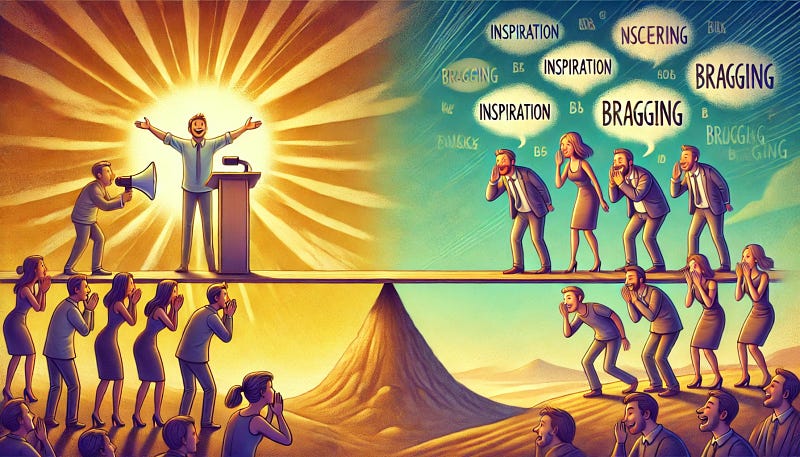
About Favoriot — Part-17: The Fine Line Between Inspiration and Bragging

Storytelling in Business

Sharing Genuine Stories Without Overdoing It

Image created using ChatGPT

The Dilemma: To Share or Stay Silent?

As I reflect on the journey of growing FAVORIOT, one question has always been at the forefront of my mind: Should we share the stories behind our successes or remain quiet and let the results speak for themselves?

I’ve often pondered this tricky balance.

Some believe in working silently, revealing success only once it becomes undeniable. On the other hand, people are curious; they want to see progress, witness small victories, and learn from their journey.

So, how do we balance being open and relatable without seeming boastful?

The Early Days: A Team Fueled by Passion

When we first started FAVORIOT, the energy was undeniable. We were a small team united by the vision of transforming how IoT could revolutionise businesses and daily life.

The excitement was palpable, but so was the uncertainty. I often asked myself, “Should we share our journey with the world? Should we discuss our vision, milestones, and progress?” I wrestled with the idea of staying silent. “No, Mazlan, keep it quiet. Let the work speak for itself,” a voice in my head said.

But at the same time, I knew that trust is built through openness and sharing the journey, not just the destination.

The Power of Storytelling

I’ve always believed that stories are what connect us. They bring people into your mission, making them feel like they’re not just buying a product but becoming part of something larger.

So why not share?” I asked myself.

Wouldn’t sharing our small wins show others that we’re genuine and making real progress?” Startups thrive on building momentum, after all.

A few people even encouraged me, saying, “Mazlan, people want to see how a company grows. They want to learn from your journey, the ups and the downs. Sharing those stories can inspire others and create a positive vibe around your business.

The Doubts: Criticism and Envy

But with the excitement of sharing also came the inevitable doubts. I realised that sharing too much could open us up to criticism.

People might misinterpret what we say. A small victory could easily be seen as bragging. Worse, some might become envious and even hope for our downfall. “Do I want to attract that kind of negative energy?” I asked myself.

The fear of inviting unwanted attention was real.

There’s also the risk of setting expectations too high. “What if we don’t meet them? What if people start doubting the authenticity of our story?” I thought. “Mazlan, if you keep showing every little success, people might think you’re exaggerating,” a close friend told me.

That struck a chord. I didn’t want FAVORIOT to be seen as all talk with no substance.

Finding the Balance

In the end, I realized that the answer wasn’t about choosing one extreme—silence or constant sharing—but about finding a balance.

The stories we tell need to be authentic.

They need to show the human side of the business, not just the successes but the challenges, struggles, sleepless nights, and small wins that keep us moving forward.

It’s about being honest.

People can tell when a story is genuine. They can sense when you’re sharing because it’s meaningful, not because you’re seeking attention. And when you’re authentic, they relate to you more deeply.

Trust is built through those authentic connections, which is crucial in business.

Emotion vs. Success Stories: The Right Mix

So, how do we balance emotion with success stories? Here’s how I see it: we share enough to let people know the heart of our company, the struggles we face, and the small victories we achieve.

We don’t paint a too glossy picture, but we don’t focus solely on the challenges.

There’s a delicate balance between being open about your journey and avoiding oversharing.

We must show people the progress, the hurdles we’ve overcome, and the small wins that push us forward. But we do it with honesty. We’re transparent, but don’t overwhelm people with too much noise.

Navigating Criticism: Staying True to Our Mission

Of course, there will always be those who view any success as bragging. That’s unavoidable.

But I remind myself that not everyone will root for you. That doesn’t mean you should stay silent. The key is how you share your story.

It’s not about boasting; it’s about connecting with people. It’s about showing them that success isn’t a straight line upward but a journey filled with twists and turns.

Looking Back: Lessons Learned from Sharing the FAVORIOT Journey

Looking back, I’m glad we shared parts of the FAVORIOT journey. It helped us build a community, create trust, and inspire others walking similar paths.

But we also learned to be mindful of how much we share and when. We don’t need to broadcast every detail, but we also don’t need to keep everything under wraps.

It’s all about balance—giving people enough to understand our mission and feel the emotion behind our work without overwhelming them with too much.

The Importance of Authenticity in Business

At the end of the day, it’s about staying true to who we are as a company and being thoughtful about how we tell our story.

We’re not just building a business; we’re building relationships.

Those relationships are strengthened through genuine, heartfelt stories—not just of success but of the journey to get there.

FAVORIOT’s growth is a testament to the power of finding that balance. By being open and honest and sharing our victories and lessons we’ve learned along the way, we’ve connected with people on a deeper level.

That connection is what continues to drive us forward.