
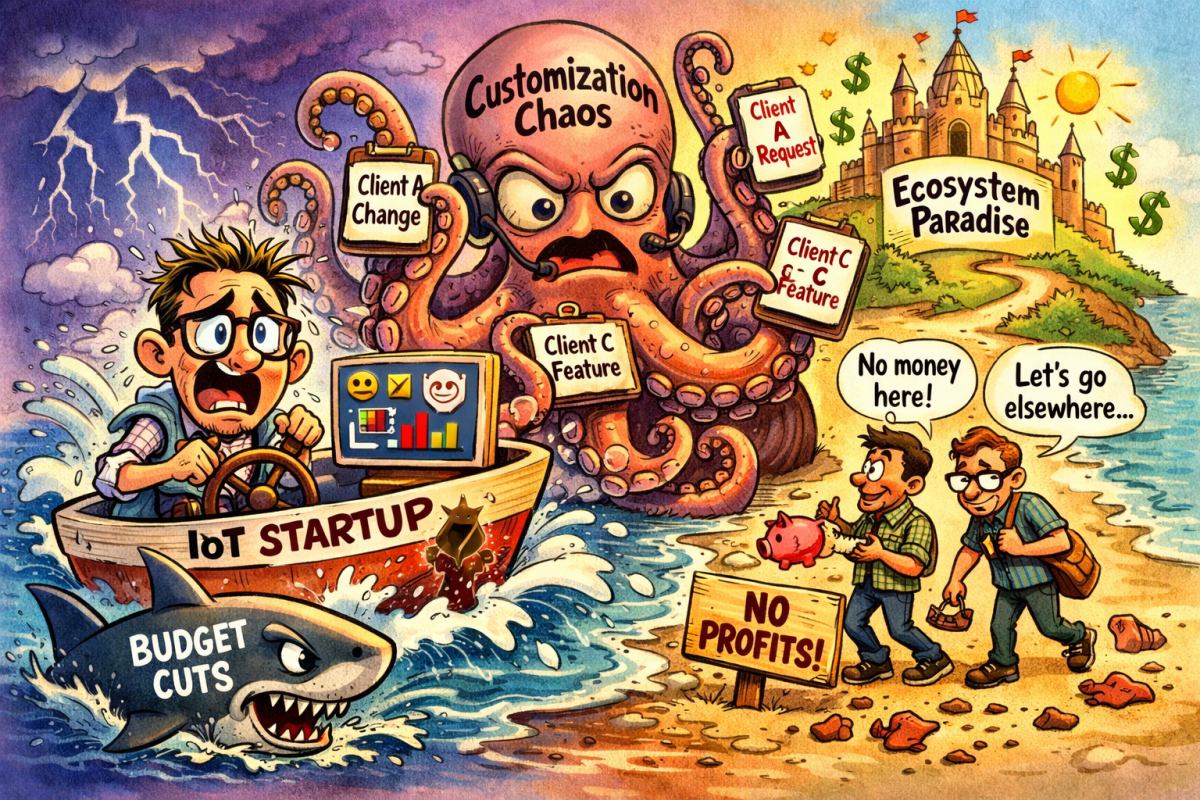
Many IoT platforms began their journey with strong foundations. They had capable engineering teams, promising technology, and even early customer traction. In the early stages, everything appeared to be moving in the right direction.
Yet over time, many of these platforms quietly stalled. Some remained small niche products. Others slowly faded from the market.
The collapse rarely happened suddenly. It emerged gradually, almost invisibly.
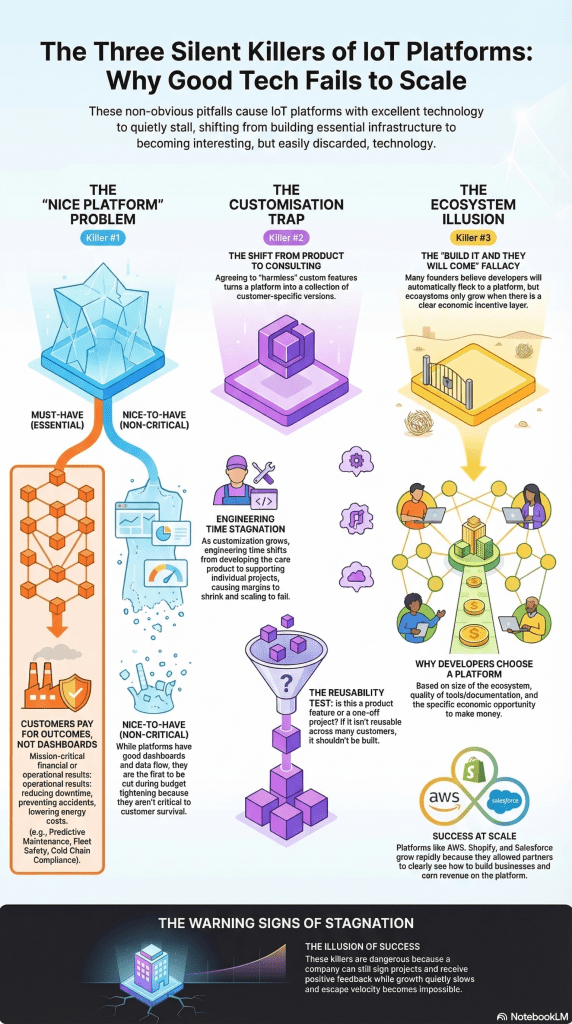
From observing the evolution of many IoT platforms over the years, three recurring patterns often appear. These are what I refer to as the three silent killers of IoT platforms.
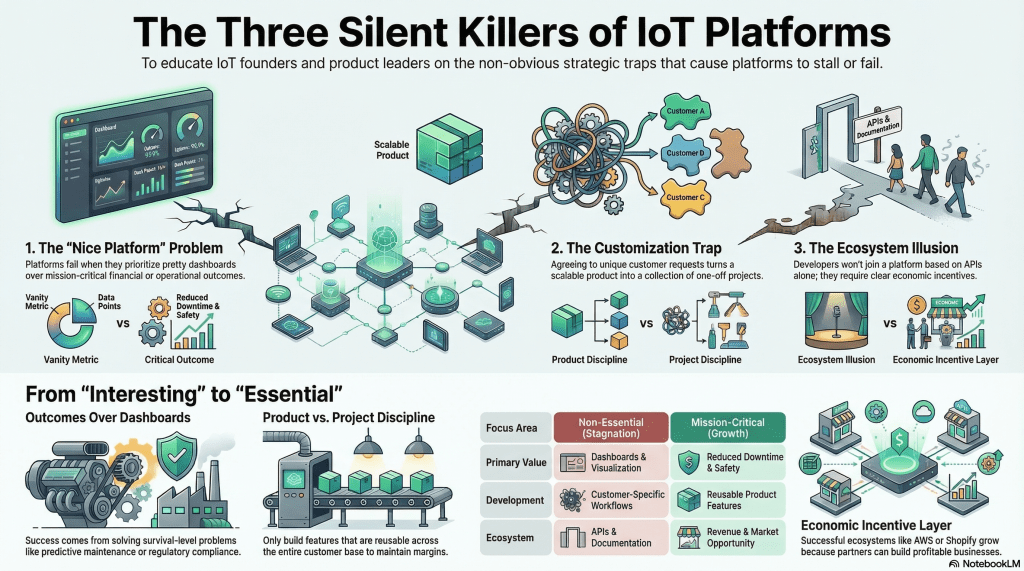
1. The “Nice Platform” Problem
The first and most common challenge is what I call the “Nice Platform” problem.
Technically, everything works as expected. Sensors transmit data. Dashboards display attractive charts. Connectivity is stable. Demonstrations during presentations look impressive.
Customers often respond with comments like, “This is very interesting.”
But the real question is much deeper than whether the technology works.
Is the platform essential to the customer’s operations?
Many IoT platforms unintentionally position themselves as helpful tools rather than critical systems. They focus heavily on features such as:
• dashboards
• device connectivity
• data visualisation
These capabilities are useful. They demonstrate the power of connected systems.
But organisations rarely allocate long-term budgets for visualisation tools alone.
Businesses invest in solutions that directly influence outcomes. What they are truly paying for are measurable results such as:
• reducing equipment downtime
• preventing operational accidents
• lowering energy consumption
• avoiding regulatory penalties
• increasing workforce productivity
When a platform is tightly connected to these outcomes, it becomes embedded in the customer’s daily operations. It becomes part of their operational backbone.
But when the platform only provides visibility without directly influencing decisions or actions, it remains optional.
And optional systems are the first to disappear when budgets tighten.
This explains why the most successful IoT deployments focus on mission-critical problems. Examples include:
• predictive maintenance in industrial environments
• fleet safety monitoring for logistics operations
• cold chain compliance for pharmaceutical distribution
• energy optimisation for large buildings
These systems cannot simply be turned off without significant operational consequences.
That is the difference between interesting technology and essential infrastructure.
2. The Customisation Trap
The second silent killer appears much later in the journey, often after the platform begins acquiring its first paying customers.
Early adopters frequently request modifications. They ask for specific dashboards, specialised workflows, or integrations with legacy enterprise systems.
At the beginning, these requests appear reasonable.
A startup needs revenue. The team wants to satisfy its customers. Agreeing to customise the platform seems like a practical decision.
However, a hidden risk gradually emerges.
Over time, the platform begins to fragment.
Instead of maintaining a single scalable product, the engineering team finds itself supporting multiple customer-specific versions:
• one version tailored for customer A
• another variation for customer B
• a different configuration for customer C
The product gradually shifts from a platform to a collection of bespoke solutions.
Engineering resources originally intended to improve the core platform are redirected to meet project-specific requirements.
At this stage, the business begins to resemble a consulting company rather than a product company.
The consequences are predictable:
• development cycles slow down
• engineering teams become stretched
• product direction becomes unclear
• operating margins shrink
Scaling becomes increasingly difficult because each new customer introduces new complexity.
Many IoT startups unintentionally move into this trap. They begin with a platform vision but gradually become project delivery organisations.
The strongest platform companies remain disciplined about this boundary.
They continuously ask a simple but critical question:
Is this a reusable product feature or a one-off project request?
If the capability cannot benefit many customers across different industries, it may not belong in the core platform.
Maintaining this discipline is difficult in the early stages when revenue pressure is high. Yet it is often the difference between building a scalable platform and building a services business.
3. The Ecosystem Illusion
The third silent killer relates to ecosystem development.
Many platform founders assume that once the platform is launched, developers and partners will naturally begin building solutions on top of it.
The belief is simple: build the platform first, and the ecosystem will follow.
In practice, ecosystems rarely grow automatically.
Developers and partners choose platforms based on several practical considerations:
• the size and activity of the ecosystem
• the availability of development tools and documentation
• the potential economic opportunity
The economic factor is frequently underestimated.
Developers invest their time where they can build sustainable businesses. If there is no clear revenue path, most will quickly move to other platforms.
This is one of the key reasons large ecosystems expanded rapidly. Platforms such as:
Amazon Web Services
Shopify
Salesforce
Apple
created strong developer communities by building clear economic incentives.
Developers could launch products, attract customers, and generate revenue through these platforms.
In many IoT platforms, the ecosystem layer is incomplete. APIs and SDKs are available, but the economic model is unclear.
For an ecosystem to grow meaningfully, partners must clearly understand:
• how they can generate revenue
• how easy it is to build solutions on the platform
• how large the addressable market is
Without these signals, the ecosystem remains limited.
Developers may experiment with the platform, but long-term commitment rarely materialises.
Why These Killers Are Difficult to Detect
One of the most dangerous aspects of these challenges is their subtle nature.
None of them produces immediate crises.
The company may still:
• secure new pilot projects
• receive industry recognition
• release new product features
• attract positive feedback from users
From the outside, everything appears healthy.
But internally, warning signs slowly emerge. Growth begins to plateau. Profit margins tighten. The product roadmap becomes fragmented.
Eventually, the platform struggles to reach the scale necessary to compete globally.
This pattern explains why many IoT platforms remain respectable but small companies rather than evolving into global infrastructure providers.
The difference between the two often lies not in technological capability but in strategic discipline.
For IoT platforms to achieve long term impact, they must move beyond attractive dashboards and connectivity features. They must anchor themselves in mission-critical outcomes, protect the integrity of their core product, and build ecosystems where partners can thrive economically.
Only then can a platform move from being an interesting technology to becoming part of the digital infrastructure that organisations truly depend on.
These lessons continue to shape how many leaders in connected systems approach platform strategy today, especially as IoT, AI, and edge computing converge to redefine how digital infrastructure is built and secured.
Discover more from Dr. Mazlan Abbas
Subscribe to get the latest posts sent to your email.

 Dr. Mazlan Abbas