How Badminton Taught Me to Write with Passion

MASTERING THE SERVE

Drawing Parallels Between Badminton and Writing

Photo by Mahmur Marganti on Unsplash

When I think about my journey as a writer on Medium, I can’t help but draw parallels to my experience playing badminton.

It’s a comparison that might seem odd at first, but stick with me, and you’ll see the connections I’ve made.

I remember the first time I picked up a badminton racket.

I was just a kid, filled with excitement and nervousness.

I had no idea how to play, but the thrill of learning something new was enough to keep me going.

Writing, especially on Medium, felt the same way.

The first time I published an article, my heart raced with anticipation and fear.

Would people read it? Would they like it?

These questions swirled in my mind, just as they did when I stepped onto the badminton court for the first time.

The Serve: Starting with an Idea

Photo by Saif71.com on Unsplash

In badminton, the serve is the starting point of every match.

Getting it right is crucial because it sets the tone for the game.

Similarly, every article begins with an idea.

I often find myself staring at a blank page, much like I used to stand at the edge of the court, ready to serve.

What should I write about?” I ask myself. “Will this topic resonate with my readers?

One day, while reminiscing about my childhood badminton matches, I had an epiphany.

Writing and badminton are not so different after all.

Both require strategy, practice, and a deep understanding of the basics.

Practice and Patience

Photo by Jackie Hutchinson on Unsplash

When I first started playing badminton, I wasn’t perfect.

I missed shots, fumbled my serves, and lost more matches than I care to admit.

But with each game, I learned.

I practiced tirelessly, honing my skills, and gradually, I improved.

Writing on Medium is no different.

My early articles could have been better.

I made mistakes, struggled with writer’s block, and sometimes doubted my abilities.

But I kept writing. Each article was a lesson, each comment a piece of feedback that helped me grow.

I recall one evening when I was particularly frustrated with my writing.

I had spent hours crafting an article, only to receive minimal engagement.

Why am I even doing this?” After a tough loss, I asked myself the same question I had asked countless times on the badminton court.

But then I remembered why I started playing badminton in the first place: for the love of the game.

Writing, too, was something I loved.

The process, the challenge, and the joy of expressing my thoughts were my reasons for writing, just as the thrill of a well-placed shot was my reason for playing badminton.

Strategy and Adaptability

Photo by Siora Photography on Unsplash

In badminton, strategy is vital.

You have to anticipate your opponent’s moves, adapt your playstyle, and sometimes, take risks.

Writing is no different.

Each article is a game, requiring a strategy tailored to the topic and the audience.

I often think, “How can I uniquely approach this subject? What angle will capture my readers’ attention?

There was a time when I wrote an article about IoT (Internet of Things), a topic I’m deeply passionate about.

I had written extensively on the subject before, but I wanted to try something different this time.

I incorporated personal anecdotes and self-dialogues to make the article more relatable.

It was a risk, much like attempting a tricky shot in badminton.

But to my surprise, the article resonated with my readers.

The feedback was overwhelmingly positive and reminded me of a victorious moment on the badminton court.

Overcoming Challenges

Photo by Vinh Thang on Unsplash

Both writing and badminton come with their fair share of challenges.

There are days when my writing feels stagnant, much like a losing streak in badminton.

I remember a particularly rough patch when I struggled to develop new ideas.

Every topic seemed mundane, every sentence forced.

It was a frustrating time, and I felt like giving up.

One evening, as I sat staring at the blue skies, I thought about my badminton training.

My coach once told me, “Focus on the basics during a difficult period. When things get tough, return to what you know best.”

This advice had helped me countless times on the court, and I decided to apply it to my writing.

I returned to the basics: writing about what I knew and loved. I wrote about my experiences, journey, and passion for IoT. Slowly, the words started to flow again, and I found my rhythm.

The Importance of Feedback

Photo by Muktasim Azlan on Unsplash

In badminton, feedback is crucial.

Coaches, teammates, and even opponents provide insights that help you improve.

Writing is no different.

Comments, likes, and shares are forms of feedback that guide my writing journey. I remember when a reader’s comment changed my perspective on a topic I had written about. It was a simple comment, but it made me see things differently and inspired me to write a follow-up article.

Engaging with my readers has been one of the most rewarding aspects of writing on Medium.

Their feedback has been invaluable, much like the advice of a coach. It’s helped me grow as a writer and motivated me to keep improving.

Finding Joy in the Process

Photo by ochimax studio on Unsplash

Ultimately, the most important lesson I’ve learned from writing and badminton is to find joy.

It’s easy to get caught up in the numbers — the views, the likes, the comments. But true fulfillment comes from writing, just as the joy of badminton comes from playing the game, not just winning matches.

I often remind myself of this when I sit down to write. “Enjoy the process,” I tell myself. “Focus on the writing, not the outcome.

This mindset has helped me stay motivated and passionate, even when the results aren’t what I hoped for.


Conclusion

Reflecting on my journey as a Medium writer, I realize how much it mirrors my experience as a badminton player.

Both have taught me the value of practice, patience, strategy, and resilience.

They’ve shown me the importance of feedback and the joy of the process. And most importantly, they’ve reminded me that success is not just about the destination but the journey itself.

So, the next time I pick up my racket or write, I’ll remember my lessons and continue to find joy.

After all, whether on the court or on the keyboard, the love of the game truly matters.

Building a Successful Startup

STARTUP STORIES

The Unseen Element Every Entrepreneur Should Know

Photo by Louis Reed on Unsplash

I vividly remember the early days of FAVORIOT. It was a time of excitement, sleepless nights, and relentless hustle.

My team and I were driven by the dream of creating a revolutionary IoT platform that would bridge the gap between technology and practical applications.

However, as we navigated the tumultuous waters of the startup world, I realized that there was one critical factor for success that many entrepreneurs, including myself, often overlooked.

Understanding the Importance of Timing

Photo by Amanda Jones on Unsplash

In the early stages of FAVORIOT, I was deeply immersed in product development.

My team and I were convinced that building the best IoT platform would guarantee our success.

We spent countless hours perfecting the features, ensuring robustness, and creating a seamless user experience. But despite our best efforts, the market response was lukewarm.

It was perplexing and disheartening.

Why aren’t people flocking to our platform?” I asked myself repeatedly.

That’s when I stumbled upon an insightful advice: timing is crucial for startup success.

It wasn’t just about having the best product but about launching it at the right time.

Reflecting on this, I realized that our initial launch coincided with a period when the IoT market was still nascent.

Businesses and consumers were not yet ready to fully embrace IoT solutions.

Learning from Mistakes

Photo by Santa Barbara on Unsplash

Our initial struggle was a tough pill to swallow but also a valuable learning experience.

I started paying more attention to market trends and the readiness of our target audience.

Instead of aggressively promoting our product, we focused on educating the market about IoT’s potential.

We conducted workshops and webinars and participated in industry conferences to raise awareness.

Maybe we were too early,” I thought. “But that doesn’t mean we can’t create the demand.

This strategic pivot proved to be a game-changer.

Slowly but surely, we saw a shift in the market’s perception.

Companies began to see the value in IoT, and our efforts to position FAVORIOT as a thought leader in the space started to pay off.

The Role of Flexibility

Photo by Wesley Tingey on Unsplash

Another key lesson I learned was the importance of flexibility.

Startups are often associated with innovation and disruption, but this should also extend to their business strategies.

Sticking rigidly to a plan can be detrimental, especially when the market dynamics constantly evolve.

I recall a specific instance where we had to pivot our approach.

We had developed a solution tailored for smart cities, but the adoption rate was slower than anticipated. Instead of abandoning the project, we adapted the solution for a different sector — agriculture.

This flexibility allowed us to find a more receptive audience and build a case study showcasing our platform’s versatility.

Adapt or perish,” I reminded myself constantly.

The ability to pivot without losing sight of the overarching vision was crucial in navigating the uncertainties of the startup world.

Building the Right Team

Photo by Hannah Busing on Unsplash

As an entrepreneur, it’s easy to fall into the trap of believing you can do everything.

I certainly did at the beginning.

However, I soon realized that building a successful startup requires a diverse team with complementary skills.

I remember the day I met Zura Huzali, our Business Development Director. Her enthusiasm for integrating IoT into various businesses was contagious.

Her insights and efforts were instrumental in driving our business development strategy.

I often told my colleagues, “Having the right people in the right roles can make all the difference.

A team that shares the vision but brings different strengths can propel a startup forward in ways one person alone cannot.

Customer-Centric Approach

Photo by Jon Tyson on Unsplash

One overlooked aspect of startup success is understanding and prioritizing customer needs.

In the initial phase, I was so engrossed in what we thought was the perfect product that I should have sought sufficient customer feedback.

A turning point for us was when we decided to engage more closely with our early adopters.

We conducted surveys, sought feedback, and, most importantly, listened.

This direct interaction with users provided invaluable insights that helped us refine our product and address pain points we hadn’t initially considered.

Our customers are our best teachers,” I realized.

By adopting a customer-centric approach, we built a product that truly resonated with the market.

Persistence Pays Off

Photo by Brett Jordan on Unsplash

The journey of a startup is fraught with challenges.

There were moments when the future seemed uncertain, and the weight of setbacks felt overwhelming.

But one thing that kept me going was my belief in our vision and my persistence in seeing it through.

I often drew inspiration from my experiences in the telecom industry and my lifelong fascination with technology.

The dream of creating a platform to transform industries kept the flame of perseverance burning bright.

Success doesn’t come overnight,” I reminded myself and my team.

It results from relentless effort, learning from failures, and constantly evolving.

The Impact of Networking

Photo by Antenna on Unsplash

Networking is another crucial factor that many entrepreneurs overlook. Building relationships within the industry can open doors to opportunities that might otherwise remain closed.

I connected with thought leaders, potential partners, and investors through conferences and industry events.

These connections not only provided valuable insights but also helped in building credibility for FAVORIOT.

A strong network can act as a support system, providing guidance, mentorship, and even collaborations that can accelerate growth.


Final Thoughts

Reflecting on my journey with FAVORIOT, I realize that the path to success is multifaceted.

While having a great product is essential, understanding the market, being flexible, building the right team, prioritizing customers, staying persistent, and networking are equally crucial.

Entrepreneurs often overlook the most important indicator of startup success, which is not a single factor but a combination of these elements working in harmony.

It’s about being attuned to the market, ready to adapt, and constantly learning and evolving.

The lessons have shaped FAVORIOT into what it is today and will continue to guide us as we strive to make a lasting impact in the IoT space.

Success is a journey, not a destination,” I remind myself. And with each step, we move closer to realizing our vision of a connected world.

In Business, It’s Better to Say “No” Than a Long Silence

BUSINESS STORIES

How do you tackle this situation differently?

Photo by Nick Fewings on Unsplash

In the early days of founding FAVORIOT, my excitement was palpable. I recall waking up each morning, brimming with anticipation for what the day might bring. I envisioned countless opportunities, partnerships, and groundbreaking projects to revolutionize industries with the Internet of Things (IoT).

My mind was a whirlwind of possibilities, and I was eager to bring these visions to life.

However, as any seasoned entrepreneur will tell you, the path to success is often fraught with challenges and frustrations that test your resolve.

One of the most frustrating experiences I encountered was the initial enthusiasm of potential customers and partners, only to be met with a deafening silence after our first meetings. I remember vividly the thrill of presenting our IoT solutions to a room full of attentive faces, each nodding in agreement and expressing keen interest. Their excitement mirrored mine, and I left those meetings with accomplishment and optimism.

Finally,” I would think, “they see the potential just as I do. This is going to be the start of something great.

However, days would turn weeks and weeks into months, with no follow-up from the very people who seemed so eager to collaborate. I repeatedly checked my email, hoping for a response that never came. The silence was not just disheartening; it was infuriating.

Photo by Kristina Flour on Unsplash

Why can’t they just say no?” I would vent in the privacy of my office. “A clear rejection is far better than this uncertainty.

It wasn’t just the absence of a reply that was frustrating, but the wasted effort in following up, hoping to reignite the interest we once shared. Each follow-up email or phone call felt like a stab in the dark, a desperate attempt to keep the dialogue alive.

More often than not, these efforts were met with continued silence. The optimism that had once fueled my days began to wane, replaced by a growing sense of futility.

Then, there were the times when the silence was broken by news that stung even more.

I would discover that the same potential partners or customers who had once expressed interest in FAVORIOT had partnered with someone else. It wasn’t just a professional setback; it felt personal.

How could they?” I’d mutter, shaking my head in disbelief. “We had something good here. Why didn’t they give us a chance?

This cycle of initial excitement, followed by prolonged silence and eventual rejection, was a bitter pill to swallow. Each instance was a reminder of the unpredictable nature of business and the often-unspoken dynamics that influence decisions.

Photo by Towfiqu barbhuiya on Unsplash

Amid these frustrations, I sought solace and advice from fellow entrepreneurs. I remember one particular conversation with a seasoned business owner who had faced similar challenges.

Mazlan,” he said, “this is part of the game. You’ll face many who won’t have the courtesy to say no outright. It’s not about you or your product; sometimes, they’re just not ready, or they’ve found something that fits their immediate needs better.

His words offered some comfort, but they didn’t ease the sting of each rejection.

Nevertheless, they reinforced an important lesson: resilience. Bouncing back from setbacks and pushing forward is crucial in the entrepreneurial journey.

Reflecting on those early days, I realize how much I’ve grown since then. The frustrations that once seemed impossible are now seen in a different light.

Each rejection, each moment of silence, was a lesson in patience and perseverance. It was during these quiet times that I learned to refine our offerings, improve our pitch, and, most importantly, to never take rejections personally.

Photo by Danie Franco on Unsplash

I began to adopt a new approach.

Instead of waiting passively for responses, I proactively sought feedback during the initial meetings.

What are your primary concerns?” I’d ask. “How can we better meet your needs?

This proactive stance not only helped gauge genuine interest but also provided valuable insights into potential customers’ minds. I learned to identify the signals of genuine interest versus polite engagement, allowing me to focus my efforts more effectively.

Moreover, I started to build a more robust network of reliable partners who understood and appreciated our vision.

These partnerships, while fewer in number, were far more fruitful and led to significant breakthroughs for FAVORIOT.

We began to collaborate on projects showcasing IoT’s real potential, gradually building our reputation and credibility in the industry.

One particularly memorable project was collaborating with a city council on a smart city initiative. It was a long shot, but our persistence paid off.

The project was a resounding success, as proof of concept for many who doubted us. It was a turning point, not just for FAVORIOT, but for me. It validated the sleepless nights, the endless follow-ups, and the resilience required to get us to that point.

Photo by Patrick Tomasso on Unsplash

Looking back, I realize that the early frustrations were a necessary part of the journey.

They tested my commitment to the vision of FAVORIOT and forced me to develop a thicker skin.

More importantly, they taught me the value of perseverance and the importance of learning from every positive or negative experience.

Today, as I stand on the other side of those challenges, I often share these lessons with budding entrepreneurs. I tell them that the path to success is rarely straightforward. It’s filled with unexpected twists and turns, moments of doubt, and frustration.

But each challenge is an opportunity to grow, learn, and improve.

If I could give you one piece of advice,” I often say, “it’s never to let silence discourage you. Use it to reflect, improve, and prepare for the next opportunity. Because, trust me, there will always be another opportunity.

Ultimately, the journey of building FAVORIOT has been as much about personal growth as it has been about professional achievement.

The early frustrations, the silent rejections, and the moments of doubt have all shaped me into the entrepreneur I am today.

And for that, I am grateful.

The road ahead remains challenging, but with each step, I carry the lessons of the past, ready to face whatever comes next.

Never Stop. Never Give Up.

THOUGHT LEADER’S STORIES

One day you will achieve your dreams.

Photo by Alexander Grey on Unsplash

Never stop searching for those who can truly appreciate your insights and contributions in IoT.

I’ve been in places where my ideas were dismissed.

My strategies were criticized.

My views were overlooked.

Perhaps it’s just me. Maybe I wasn’t clear enough. Yes, perhaps it’s just me.

But what matters most is that you don’t give up.

First, you must have faith in yourself.

Your knowledge. Your expertise. Your innovative potential.

Then, leverage social media to display your prowess to the world.

(yes, it’s an incredibly powerful tool that only a fraction are utilizing effectively).

Through engaging content and my educational videos, the team at Asia IoT noticed my efforts.

They invited me to speak at the Asia IoT 2019 in Singapore, alongside industry pioneers from Germany, Japan, and Canada.

This event is about IoT innovation globally.

The brightest minds in technology and digital transformation gather here to exchange ideas and forge partnerships.

From then onwards, I have received many invitations as Keynote and Invited Speakers.

Now, turning back to you…

Never undervalue your capabilities.

Yet, always remain humble.

Recognize that you don’t know everything.

Continue to learn.

Never stop pushing forward. Your opportunity is just around the corner.

Photo by Fernando Brasil on Unsplash

19 Signs Your Startup is More Successful Than You Think

STARTUP STORIES

Stop being too hard on yourself; your startup journey is on the right track!

Photo by Mario Gogh on Unsplash

This article is a chance to pause and reflect. Take a deep breath and allow yourself a moment to appreciate your progress and what you’ve achieved in your startup so far.

Here are 19 indicators, some clear and others more subtle, that suggest you’re doing better than you might think:

  1. You frequently second-guess decisions. 
    Doubt isn’t a sign of weakness; it indicates you’re open to growth and self-improvement. Reevaluating decisions means you’re thoughtful and forward-thinking.
  2. You’ve secured some funding.
    Whether it’s from savings, angel investors, or a venture capital round, securing funding means someone believes in your vision. Celebrate that vote of confidence.
  3. Your team is growing.
    Even if it’s just hiring your first employee or a co-founder joining you, growth in your team is a sure sign of startup success.
  4. You’ve evolved from your original idea.
    Pivoting doesn’t mean failure; it shows you’re learning from interactions with the market and adjusting accordingly. That’s innovation at work.
  5. You’ve experienced failure.
    Each failure is a lesson that refines your business model. If you’ve failed but kept going, you’re in the resilient minority.
  6. You don’t worry about immediate shutdown.
    Having enough runway to plan beyond the next few months is a small luxury in the startup world. If you’re not in survival mode every day, you’re doing something right.
  7. You have loyal customers.
    Even if it’s just a handful of loyal customers who love what you do, their continued support is a sign you’re adding real value.
  8. You’ve received unsolicited customer feedback.
    Whether it’s praise or constructive criticism, feedback means customers care about your product enough to want to see it improve.
  9. You’ve declined opportunities.
    Saying no to wrong fits, whether potential clients, hires, or partnerships, means you’re focusing on what truly aligns with your mission.
  10. Your product has iterated several times.
    Each iteration means you’re closer to finding the best market fit. Continuous improvement is a cornerstone of successful startups.
  11. You understand your market better than when you started Insight into your market is invaluable.
    If you know your customer well, you’re leaps ahead of many startups.
  12. You’ve survived more than one “make-or-break” scenario.
    Getting through tough challenges means your startup has the resilience to face the ups and downs of the business world.
  13. You have a dedicated workspace.
    Having a specific place where your team can focus and collaborate is a sign of establishing a solid foundation.
  14. You’ve let go of what doesn’t work.
    Knowing when to cut losses is as important as knowing when to push forward. This ability to adapt is crucial for long-term success.
  15. You’re excited by challenges.
    Seeing challenges as opportunities rather than obstacles is a sign of a positive mindset, crucial for entrepreneurial success.
  16. You know how to manage stress
    Balancing the high pressures of startup life is no small feat. If you’ve developed coping mechanisms, you’re setting yourself up for sustained effort.
  17. You’re thinking about scaling.
    Planning for growth, even if it’s just preliminary, means looking towards the future with optimism.
  18. You’ve established a brand identity.
    Having a clear brand identity helps in making your startup memorable and recognizable. This is key in crowded markets.
  19. You’re still passionate.
    Continuing to have passion for your venture is perhaps the most telling sign that you’re on the right path. Many lose this spark, but if you’ve still got it, you’re more than on track.

You’re laying down the tracks for future success, so keep pushing forward and stay grounded in your own progress, not someone else’s.

Your journey is unique, and you’re doing better than you think!

Photo by Israel Andrade on Unsplash

This is the story of my Startup journey — Startup Survival.

Why Many Smart Cities Failed? Here’s How to Avoid.

TIPS FOR SMART CITIES SUCCESS

Learn the 8 Reasons for Failures (And Avoid Them)

Photo by Brett Jordan on Unsplash

Not a member? Click here to access the whole story for free.

I’ve observed a transformation as cities aspire to become ‘smart’ — a vision that suggests a seamless marriage between urban life and advanced technology.

The promise encompasses efficiency, sustainability, and a newfound ease of living.

Yet, as I reflect on the different initiatives that have stumbled or even failed, I realize that the pathway to realizing such smart cities is fraught with a multitude of challenges.

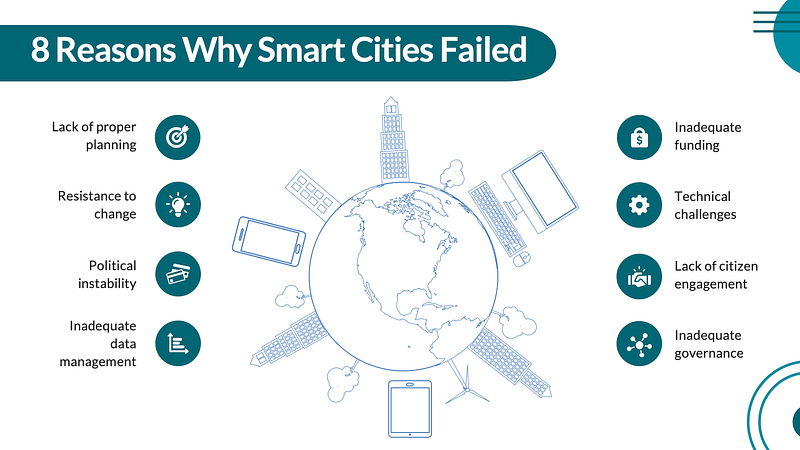
8 Reasons Why Smart Cities Failed

1 — Lack of Planning

As I analyze these issues, I can’t help but start with planning — or the lack thereof.

In my experience, planning for a smart city is like conducting an orchestra; every instrument, or in this case, technology, and infrastructure, must be in tune.

Without a meticulous blueprint and long-term strategy, resources can be squandered, and the resulting chaotic leads to systems that fall short of their potential, creating waste rather than wonder.

2 — Resistance to Change

I often ponder resistance to change, an innately human trait that presents as a formidable barrier.

I’ve seen how the reluctance of governance bodies and the hesitance of city dwellers, often born from misunderstanding or fear, can stifle the adoption of smart initiatives.

I try to understand and address this resistance, recognizing that support for these projects is as much about trust in their benefits as the technologies themselves.

3 — Political instability

Political instability, too, has a role to play.

In my experience, politics’s tumultuous nature can disrupt the continuity essential for smart city visions to thrive.

A change of guard can often lead to a change of heart, as new leadership brings new priorities, potentially diverting from the established path and undermining the foundations laid by smart city projects.

4 — Data Sharing and Management

Then, there’s the issue of data — its management, or rather, the lack thereof.

Data is the lifeblood of a smart city, and its mismanagement can result in inefficiencies that erode public trust.

I reflect on the privacy concerns that arise and the effectiveness of the smart solutions that hinge on the ability to manage this data responsibly.

5 — Lack of Funding

Funding is another matter that occupies my thoughts.

The realization of a smart city comes with a price tag, often a hefty one.

Insufficient funding can lead to half-built dreams or compromises on quality, fueling skepticism and doubt about the value of these initiatives.

6 — Complex Technological Challenges

Technical challenges also loom large in my contemplation.

Integrating IoT, 5G, AI, and more into an interoperable ecosystem requires ongoing maintenance and updates.

When these technical demands are not met, the result can be systems that don’t live up to their promise or, worse, fail entirely.

7 — Lack of Citizen Engagement

The role of citizens, too, cannot be understated.

I’ve observed a disconnect between the solutions offered and the real needs of the inhabitants without their engagement.

The success of a smart city is in part defined by the participation of its residents, creating a sense of shared ownership and responsibility.

8 — Lack of Strong Governance

And governance — this, perhaps, is one of the most complex reflections.

I consider how existing governance structures might not be suited to the novel demands of a smart city.

The absence of clear regulatory frameworks, accountability, and coordination among sectors can lead to inefficiencies that impede the functioning of smart cities.


As I have come to understand, the creation of smart cities transcends technology—it’s about the harmony between innovation and the human elements that underpin our urban existence.

For smart cities to flourish, learning from past shortcomings is imperative.

We must build resilient, inclusive frameworks that respect urban life’s technological and societal aspects.

I stand committed to this vision, combining insight with innovation to unlock the true potential of smart cities.

It’s a future that is within our grasp, should we choose to reach for it with wisdom and foresight.


More Stories about Smart Cities:

https://mazlanabbas.com/how-smart-city-tech-can-boost-your-citys-finances-9d77b3aa1ae7https://mazlanabbas.com/how-smart-city-tech-can-boost-your-citys-finances-9d77b3aa1ae7https://mazlanabbas.com/how-smart-city-tech-can-boost-your-citys-finances-9d77b3aa1ae7https://mazlanabbas.com/how-smart-city-tech-can-boost-your-citys-finances-9d77b3aa1ae7https://mazlanabbas.com/how-smart-city-tech-can-boost-your-citys-finances-9d77b3aa1ae7


Let’s join over 8,100 subscribers and get an email whenever Mazlan Abbas publishes.

https://mazlanabbas.com/how-smart-city-tech-can-boost-your-citys-finances-9d77b3aa1ae7

The Early Stumbles and Mess-Ups That Shape Us

Startup Stories

Mistakes that you can avoid, too!

The early stumbles and mess-ups that all founders encountered

Alright, let’s dive in and chat about this whirlwind adventure of diving headfirst into the IoT scene with my squad at MIMOS. You know, being under the wing of MOSTI really gave us that, “Yeah, we can totally revolutionize wireless tech,” kind of vibe. We were all about pushing the boundaries with the 6LoWPAN standards — like, who even knew what that was back then?

But let me tell you, jumping ship to the telecom sector was like swapping a comfy bean bag for a stiff office chair.

Launching our IoT platform under Favoriot in 2017?

Man, we were on cloud nine, picturing this tech-hungry market just waiting for a slice of IoT magic.

Turns out, it wasn’t all confetti and fanfare.

Now, let’s talk facepalm moments — seven of them, to be exact.

First off, we thought the talent pool was Olympic-sized, but when we dipped our toes in, it was more like a kiddie pool. Getting folks to jump on our platform was like trying to start a campfire in a downpour.

Then, we peered into the halls of academia, hoping to find IoT wizards in the making. Spoiler alert: IoT education was basically a chapter they skipped. Back to the drawing board, right?

And oh, our brilliant idea to use YouTube as a training ground for Favoriot?

Big oops there.

People craved real-deal courses, not just snack-sized tutorials.

Client onboarding was another story. Imagine trying to explain rocket science to your grandma — that was us with IoT to our clients. They needed that guiding star, and we were still fumbling with the telescope.

Budgeting was another beast. Picture a snail race — that was the pace of decision-making in these orgs. No one wanted to sign the check without knowing the full menu.

The lack of a project catalyst was like waiting for paint to dry. But then, good ol’ 2020 hit, and suddenly digital transformation wasn’t just a buzzword anymore. Thanks, Covid?

And those training opportunities we breezed past? If only we’d hit pause on coding and marketing and actually looked around. Hindsight, huh?

Wrapping this up, those facepalms?

Gold mines, each one. They schooled us big time.

Now, we’re riding the IoT wave like pros, all thanks to those early stumbles that turned into our roadmap.

So, here’s to the mess-ups that shape us — cheers to the lessons learned and the wins scored on this wild IoT ride.

Poem: Undimmed by the Sun

Rising from Shadows

Photo by Spencer Goggin on Unsplash

In the heart of night, where shadows loom and falter,

A soul whispers to the stars, unyielding, never to alter.

From the depths of despair, where silence reigns supreme,

Emerges a spirit, emboldened, chasing a dream.

Through the tapestry of failures, a resilient thread is spun,

A narrative of courage, undimmed by the sun.

Each setback, a lesson; each fall, a rise anew,

A journey of becoming, a path only a few pursue.

Amidst the tempests of doubt, a steadfast ship sails,

Guided by a heart that believes, where reason pales.

The waves of adversity, fierce and unkind,

Forge a will of steel, a resilient mind.

From the ashes of defeat, a phoenix takes flight,

Soaring above the clouds, a beacon of light.

In the crucible of hardship, character is made,

A testament to perseverance, that never shall fade.

Braving the storms, undeterred by the night,

Embracing the struggles, with all might.

In every scar, a story of victory is told,

A testament to bravery, bold and bold.

The summit beckons, with promises of new views,

A realm of possibilities, where dreams ensue.

Photo by Gaurav K on Unsplash

Rising from the failures, a spirit reborn,

In the heart of hardship, a legend is born.

So march forth, intrepid soul, with hope as your guide,

Through the valleys of despair, with strides wide.

For in the end, it’s not the triumphs that we recall,

But the brave journey through hardships, standing tall.

Photo by Thomas Fryatt on Unsplash

Avoid These 10 Mistakes and Become a Better Writer in 2024

Image created using Midjourney by Author of Startup Journey

I have written over 100 articles in 2023, but over 80% had at most ten views.

It’s sad, and it’s tiring.

We write to share our ideas and knowledge among our readers.

In the early part of the year, I had almost zero increase in followers.

As 2023 ended, I took a step back and analyzed what had gone wrong.

Here’s a list of mistakes I will not repeat next year, and you can probably try to avoid doing that, too.

Writing Mistakes I Made in 2023

  1. Lack of Emotional Depth in Writing: I often wrote mechanically, neglecting to infuse my work with genuine passion or emotion, which made my writing seem detached and unengaging.
  2. Focus on Knowledge Rather Than Problem-Solving: My topics were heavily knowledge-oriented, lacking opportunities to address and solve real-life problems that could have added more value to the readers.
  3. Failure to Connect with the Audience: I chose topics that did not resonate with my readers, resulting in a disconnect between my content and the interests or needs of my audience.
  4. Neglecting the Power of Headlines and SEO: I should have noticed the importance of crafting catchy, attention-grabbing headlines and optimizing my content for search engines, which limited my reach and visibility.
  5. Overly Complex Sentences: My writing often included long-winded, complex sentences, which made the content difficult to follow and less reader-friendly.
  6. Superficial Engagement with Fellow Writers: My interactions with other writers needed more sincerity and depth, preventing me from building meaningful connections and learning from my peers.
  7. Unstrategic Republishing of Old Content: I randomly republished old articles from various blogs without a strategic plan or updates, which didn’t add fresh value or relevance to the content.
  8. Not Keeping Up with Trending Topics: I failed to research and analyze hot, popular topics in my field, missing out on riding the wave of trending content that could have attracted more readers.
  9. Shortage of Practical “How-To” Guides: My content lacked practical, step-by-step “How-To” guides, essential for providing actionable advice and solutions to readers.
  10. Inconsistent Sharing of Personal Writing Experiences: I did not regularly share personal stories about my writing experiences, including failures and achievements, which could have made my journey more relatable and inspiring to others.

The above might not be an extensive list, but it is undoubtedly a list of mistakes I should avoid.

How about you?

View at Medium.com

Image created using Midjourney by Author of Startup Journey

If you are interested in my startup entrepreneurial journey, check out my latest eBook.

My Three Product Failures: Unveiling Lessons for Startup Survival

Photo by the blowup on Unsplash

Creating something new is thrilling.

As startup founders, we’ve faced this excitement three times.

Each time, we stumbled upon failure.

This is our tale of three failed products and the lessons we learned.

Our products weren’t the only ones in the market. Yet, there was no clear benchmark to measure success.

Raqib was our first product that caters to the market for senior citizens.

Favorsense is the second product that should solve the problems of citizen engagement for local councils.

Our third product was an alternative to Raqib, a mobile app called Dscover that can track users’ locations. But it is also meant for family members or friends who track each other’s activities.

View at Medium.com

We invested time, effort, money, and belief. Acknowledging their failure was tough.

Identifying a failing product is challenging. For us, the first red flag was steady low revenue.

Despite marketing efforts, the income was just a trickle, far from our expectations.

Letting go of our creations was hard. We had to stop supporting the failed products.

This harsh reality taught us to accept, learn, and move forward.

Photo by Brett Jordan on Unsplash

Here are the crucial lessons we learned from our missteps:

  1. Minimal Viable Product (MVP) Importance: Having an MVP helps test market waters before a deep dive. It allows for initial response assessment and iteration, saving hefty upfront investment in a possibly unviable full-fledged product.
  2. Value of Early Users: Early adopters are like a compass, their feedback is instrumental in refining the product to meet market demands.
  3. Securing Paying Customers Early: Early paying customers validate your product’s value and kickstart revenue generation.
  4. Having Reference Sites: Success stories or reference sites boost prospective customers’ confidence and enhance product credibility.
  5. Flexible Pricing Model: A rigid pricing can deter potential customers. Experimenting with various pricing models helps find a balance that attracts and retains the target audience.

Looking back, our failed products were stepping stones towards success.

Photo by Ev on Unsplash

Each failure illuminated new startup aspects.

Though the journey was challenging, it molded us into resilient, well-informed founders ready for future entrepreneurial hurdles.


Our fourth product seems to be our savior, and it has been gaining market traction. Now, it’s about time for us to scale up.

View at Medium.com