

“Am I crazy to compare startups with badminton?” I asked myself.
“Maybe. But the more I think about it, the more it makes sense. Every serve, every rally, every drop shot—it’s like reliving every pitch, every pivot, every sleepless night.”
Let me take you into the world of birdies and business, of rackets and risk. Because I believe if you understand how badminton is played—not casually in your backyard, but in intense, sweaty tournaments—you’ll understand the spirit it takes to build a startup.
1. The First Serve: The Idea
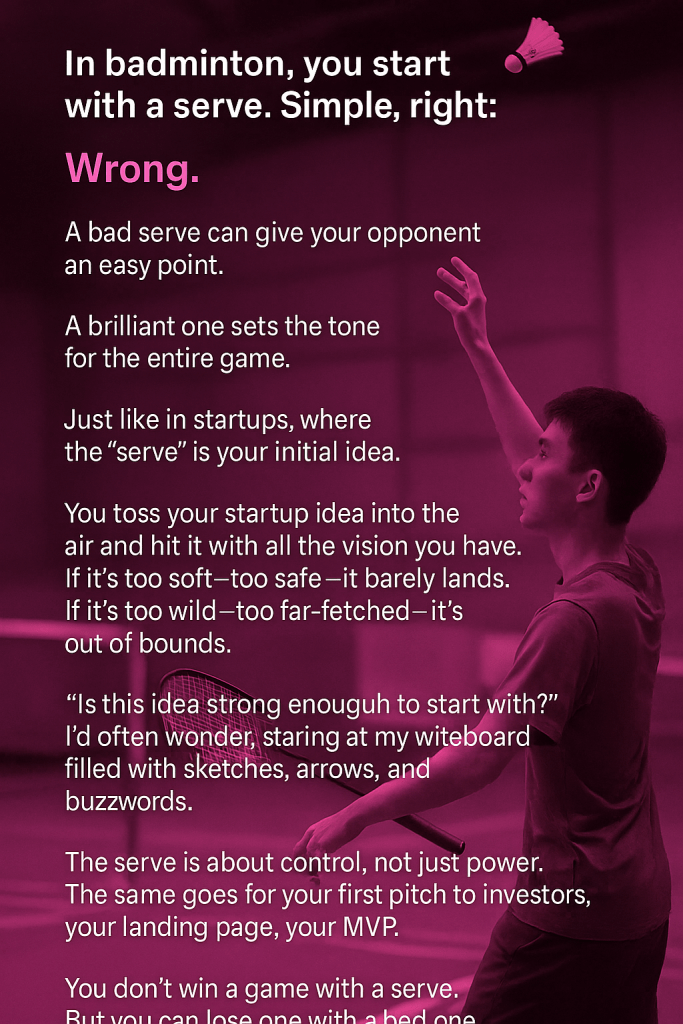
In badminton, you start with a serve. Simple, right?
Wrong.
A bad serve can give your opponent an easy point. A brilliant one sets the tone for the entire game.
Just like in startups, where the “serve” is your initial idea. You toss your startup idea into the air and hit it with all the vision you have. If it’s too soft—too safe—it barely lands. If it’s too wild—too far-fetched—it’s out of bounds.
“Is this idea strong enough to start with?” I’d often wonder, staring at my whiteboard filled with sketches, arrows, and buzzwords.
The serve is about control, not just power. The same goes for your first pitch to investors, your landing page, your MVP. You don’t win a game with a serve. But you can lose one with a bad one.
2. The Rallies: Execution and Iteration
Now comes the rally—the heart-pounding exchanges where you and your opponent hit the birdie back and forth across the net. This is execution.
This is where your startup lives most of its life.
Every shot you take is like a new feature you launch, a customer you onboard, or a bug you fix. You think fast. You move faster. You anticipate your opponent—your competitor.
You see, in badminton, you don’t always smash. You drop, you lob, you defend. You read your opponent’s stance and respond accordingly.
Likewise, building a startup isn’t about brute force. It’s about strategy. You have to adjust to the market, respond to feedback, outmaneuver bigger players. And sometimes, just sometimes, you make that perfect shot—a feature your customers absolutely love. The crowd (or at least your team) goes wild.
“Is this the moment? Should I smash it now or keep playing safe?”
Just like in rallies, timing is everything. Wait too long to act and the market changes. Act too soon and you burn out. The best founders, like the best players, read the game as they play.
3. The Smashes: Big Moves and Big Risks
Ah, the smash.
That glorious, thunderous, aggressive shot. It’s risky. But when it lands—it’s unforgettable.
In startups, your smash is your bold move. Maybe it’s raising a million-dollar round. Maybe it’s launching internationally. Maybe it’s pivoting entirely.
When you go for it, you’re saying: “I’m all in.”
But here’s the thing about smashes: if you mistime it, you fall flat. You open yourself up. You give your opponent (or the market) a chance to counterattack.
“I’ve missed a few of those smashes,” I admit. “Overhired. Overpromised. Underestimated the cost of scaling. It hurt.”
Yet you don’t stop smashing. Because if you only play defensively, you’ll be forever stuck reacting. Great players—and great founders—know when to go big.
4. Footwork: The Often Overlooked Key
Your ability to move across the court, to balance, to recover after each shot.
Talk to any coach, and they’ll tell you the secret to winning isn’t just about arm strength or racket skills. It’s footwork.
In startups, footwork is your discipline. Your routines. Your processes. Your adaptability.
“Was I flexible enough when things didn’t go as planned? Did I position my team in the right direction?”
Without good footwork, you’re always a step too late.
Without startup discipline—clear goals, consistent communication, product-market fit—you’ll always feel like you’re chasing, not leading.
The startup world celebrates flashy launches and viral growth, but real longevity comes from founders who know how to move, not just shoot.
5. Endurance: The Mental and Physical Game
Badminton looks easy—until you play a full set.
You’re sweating, your legs are on fire, your lungs are screaming, but the game isn’t over. You’re only halfway through.
Building a startup is no different. It looks glamorous—until you’re in it. Burnout, loneliness, imposter syndrome—these aren’t bugs; they’re features of the founder journey.
“Why does this feel harder than expected?” I’ve asked myself during the 3 a.m. coding marathons and the ‘no replies’ to important emails.
That’s when you dig deep. Just like athletes. You focus on recovery, resilience, routines.
Your team becomes your doubles partner—they catch what you can’t reach, they motivate you when your shoulders droop, and sometimes, they even push you back into the game when you feel like quitting.
6. The Coach and the Crowd: Mentors and Supporters
Behind every great player is a coach. Behind every startup is a mentor, advisor, or investor who believes when the scoreboard looks bleak.
You need people who tell you the brutal truth—“Your strategy is off.” Or, “You’re focusing on the wrong customer segment.”
And then there’s the crowd. The people cheering for you. Your early adopters, your friends who share your launch post, your parents who still ask what exactly it is you’re building.
“Do they really get what I’m trying to do?” Maybe not. But their belief… it carries you.
7. Match Point: The Exit or the Next Game
Eventually, there comes the match point. You’re either about to win—or lose.
Sometimes, your startup succeeds. You find product-market fit. You scale. You get acquired or go public. That’s your championship point.
But sometimes, the startup ends. Not with a smash, but a whisper. And it’s OK.
Because like in badminton, there’s always another game. Another tournament. Another idea.
You’ve trained. You’ve learned. You’re better than you were before.
Final Thoughts: Play to Win, But Love the Game
Here’s the truth: You don’t always control the outcome in badminton. A lucky net cord, a bad call, a slippery court—anything can happen.
Same with startups. Timing, trends, luck—they all play a part.
But what you can control is how you play. With heart. With hunger. With humility.
And when you love the game, win or lose, you walk off the court knowing…
“I gave it everything.”
Just like I did when I built FAVORIOT.
And just like I’ll do again for my next game. My next serve. My next smash.
Are you ready to pick up your racket and build your startup like a champion?
Because the court is waiting.
 Dr. Mazlan Abbas