
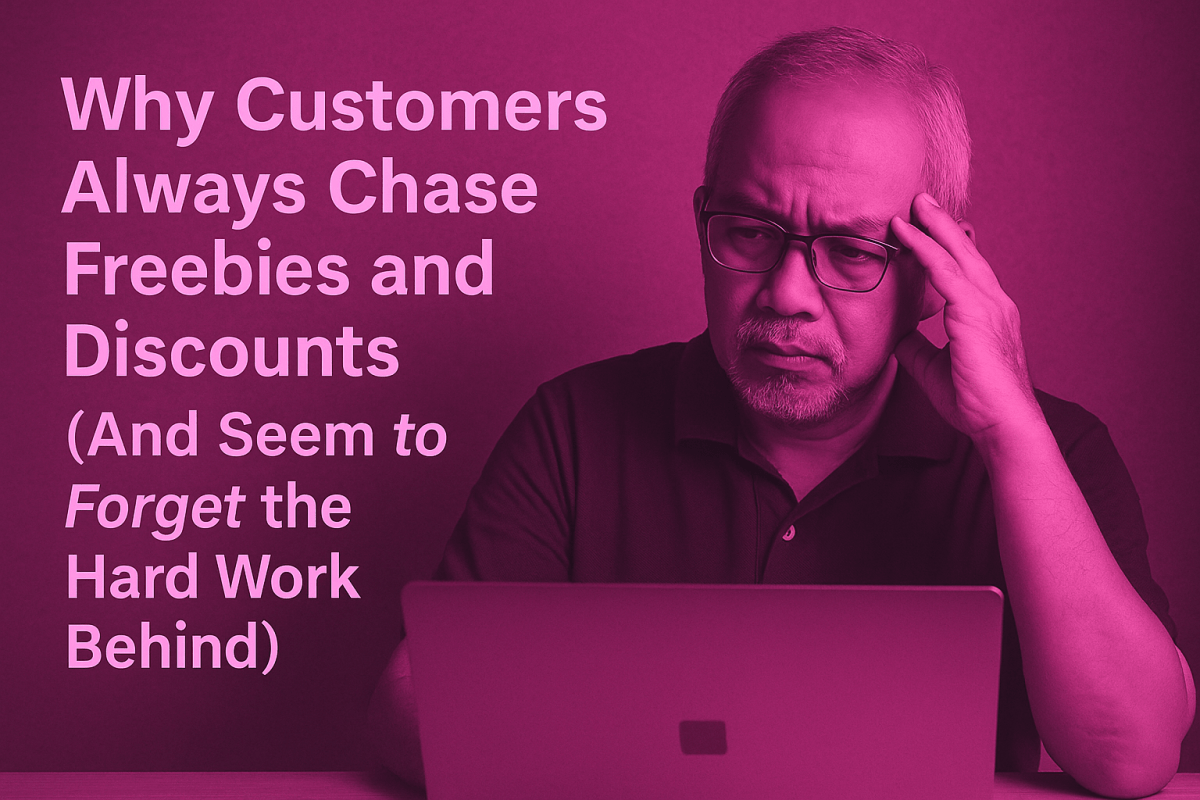
“Why are people like this? Don’t they realize how much blood, sweat, and tears went into building this thing?”
I caught myself thinking that one night, staring blankly at the computer screen, after yet another customer asked for a discount. Or worse — asked if they could get it for free.
I sighed. Come on, Mazlan. Think deeper. Try to understand them, not judge them.
And so began my exploration into the psychology of why people love free stuff and discounts — and why they seem to have little empathy for the hard work poured into products.
The “Free” Mentality is Hardwired into Us
First, let’s be honest: we all love free things.
Free samples at the supermarket?
Limited-time free downloads?
“Buy one, free one” promotions?
Sign me up!
There’s actually a psychological term for this: zero price effect. Studies show that when something is offered for free, we assign it disproportionately high value. Rationally, a $1 chocolate bar and a $0 chocolate bar shouldn’t feel that different, but emotionally, free triggers excitement, joy, and a fear of missing out (FOMO).
It’s almost as if the word free lights up a part of our brain that says, “This is too good to pass up!” — overriding logical thought.
But still… do they have to ignore all the effort behind it?
I shook my head, feeling the familiar sting.
Why Discounts Become an Expectation
Discount culture didn’t come out of nowhere. Businesses themselves — in a bid to outdo each other — trained customers to expect discounts.
Sales. Coupons. Festive offers. Black Friday madness. 11.11 crazy deals.
It’s a never-ending cycle:
If your competitor offers 10% off, you feel pressured to offer 15%. Customers, seeing this pattern, naturally think: “Never buy at full price. Just wait a little, there’ll be a discount.”
And so it goes.
Over time, people don’t just hope for discounts. They demand them. They think, “If this product doesn’t come with a discount or free trial, something must be wrong.”
In their minds, it’s just business. They don’t see the late nights you pulled, the months spent perfecting the code, or the number of rejections you swallowed before even launching. They only see the price tag.
It’s not personal, I told myself. It’s conditioning.
The Disconnect: Makers vs. Buyers
Here’s where the real hurt happens.
As creators, we live the product.
Every feature added was a mini-victory. Every bug fixed was a tiny battle won. Every negative feedback was a dagger straight to the heart.
We remember every painful step.
They only see the final polished result.
Imagine spending three years painting a masterpiece, only for someone to say,
“Can I get it cheaper? Or free? After all, you enjoy painting, right?”
Ouch.
Ouch again.
The problem isn’t that people are cruel.
It’s that there’s a huge empathy gap between creation and consumption.
Consumers don’t experience the creation journey. They don’t feel the sacrifices, the sleepless nights, the financial risks.
They just see a product on a shelf — and instinctively behave like bargain hunters.
They don’t mean to devalue your work.
They just don’t see the invisible story behind it.
Entitlement in the Age of Abundance
Let’s be real — we live in a time of too much choice.
If you don’t offer it for free, someone else will.
If you don’t lower your price, they can find a dozen alternatives online.
This abundance fuels a sense of entitlement:
“Why should I pay full price when I know I can get something similar for free?”
The internet didn’t just make access easier — it made everything feel disposable.
Music. Movies. Software. Apps.
So, even if your work took years to craft, the modern consumer mindset often treats it like a Netflix subscription:
“Next!”
It’s brutal. But it’s reality.
So… Are Customers Just Ungrateful?
I wanted to scream yes.
But deep down, I realized… no.
Most customers aren’t consciously trying to insult developers or devalue companies.
They are simply operating within an environment they didn’t create:
An environment where free trials, freemiums, and 90%-off deals are the norm. An environment where “value” is determined by instant gratification, not by the depth of effort. An environment where how something was made is invisible.
If they knew the story, maybe they would appreciate it more.
If they knew the struggle, maybe they would feel differently.
But because they don’t, it falls on us, the makers, to tell that story. Again. And again. And again.
How Makers Can Respond (Without Losing Their Soul)
Here’s the truth:
You can’t undo decades of consumer behavior overnight.
But you can:
Educate your customers. Share your journey. Tell them about your process. (Behind-the-scenes videos, blogs, founder’s notes — they help bridge the empathy gap.) Stand firm with your value. If you know your work deserves a certain price, don’t cheapen it with desperate discounts. (Offer value, not just lower prices.) Offer entry points without devaluing your work. (Example: free trials with clear boundaries. “Experience it first — then support us by subscribing.” It’s a different psychology than “always free.”) Connect emotionally, not just commercially. (Brands that succeed today are those that have meaning. Customers support stories more than they support products.)
And maybe, just maybe…
Over time…
More people will say:
“I see the heart behind this. I want to pay full price — and even tip you extra.”
Is it naive to hope for this?
Maybe.
But I’d rather build with hope than surrender to cynicism.
Final Reflection: Freebies, Discounts… and Respect
At the end of the day, customers will always love free stuff and discounts.
It’s human nature.
It’s the market reality.
But respect?
Appreciation?
Understanding the work behind a product?
That has to be earned — not begged for.
It happens when we, as creators, step out from behind the curtain and invite them into our world.
When we make them feel the journey, not just see the result.
Maybe then, getting a “free trial” won’t feel like getting something for nothing —
It will feel like being gifted a piece of someone’s dream.
And maybe, just maybe, that will change everything.
I close my laptop with a small smile.
Tomorrow, I’ll tell the story again. And maybe someone will listen.


 Dr. Mazlan Abbas