I’ve identified nine critical mistakes that were holding me back from becoming the writer I aspire to be.
Photo by krakenimages on Unsplash
Writing has always been a part of who I am. Reflecting on the past year, I realize that I penned over 100 articles in 2023, yet astonishingly, more than 80% of those garnered a mere ten views or fewer.
This statistic isn’t just a number – it’s a stark reminder of the disconnect between my efforts and the impact I hoped to achieve.
As writers, our primary aim is to disseminate our ideas and knowledge, to reach an audience that finds value in our words.
The realization that I wasn’t reaching my readers as effectively as I wanted was both saddening and exhausting.
In confronting this reality, I aimed to refine my craft and better connect with my audience.
Through this process, I’ve identified nine critical mistakes that were holding me back from becoming the writer I aspire to be.
As I share these insights, I hope you’ll join me in transforming our writing endeavors.
Photo by Santa Barbara on Unsplash
Mistake 1: Ignoring the Audience
One of the fundamental errors I realised was writing without a clear understanding of who my audience is. “Who am I writing for?” I often asked myself during my reflections.
Without knowing who the readers are, what they like, or what information they seek, my articles often missed the mark.
Moving forward, I’ve learned the importance of tailoring my content to the interests, needs, and preferences of my target audience, ensuring that each piece resonates and engages.
Mistake 2: Skimping on Research
Initially, I prided myself on speed – how quickly I could churn out an article.
However, this often came at the expense of depth and accuracy. “Am I providing real value?” I would wonder, as I hastily wrapped up another piece.
I’ve come to realize that thorough research not only enhances the quality of the content but also builds credibility with my readers.
Investing time in research is non-negotiable for producing informative and reliable content.
Mistake 3: Overlooking SEO
In today’s digital age, understanding and implementing Search Engine Optimization (SEO) is crucial.
I used to write purely from a creative perspective, neglecting how search engines understand and prioritize content. “Why aren’t people finding my articles?” I frequently pondered, unaware that I was invisible to search engines.
Learning about keywords, meta descriptions, and how to structure content for SEO has become a cornerstone of my writing process, helping my articles gain the visibility they deserve.
Mistake 4: Neglecting the Power of Editing
I confess, I was often so eager to hit ‘publish’ that I bypassed rigorous editing. “Is this really my best work?” I’d reluctantly think, knowing deep down I could improve it.
Editing is not just about correcting grammar or spelling; it’s about refining thoughts, strengthening arguments, and enhancing clarity.
Now, I dedicate ample time to revise and polish each article, recognizing that great writing is as much about revision as it is about creation.
Mistake 5: Failing to Engage with the Community
Writing is not a one-way street.
Initially, I neglected the social aspect of writing online – engaging with readers and other writers. “Why am I feeling so isolated?” I often lamented, not realizing that I wasn’t participating in the community.
Engaging in conversations, responding to comments, and connecting with others in the field are practices I now embrace enthusiastically.
These interactions enrich my understanding and expand my reach.
Mistake 6: Inconsistent Publishing
My publishing schedule was erratic at best.
There were bursts of activity followed by periods of silence. “How can I expect to build a following?” I questioned, seeing the effects of my inconsistency.
Establishing and sticking to a regular publishing schedule ensures that readers know when to expect new content, fostering a loyal and engaged audience.
Mistake 7: Not Diversifying Content Formats
I stuck rigidly to traditional article formats, missing out on the diverse ways people consume content. “Could I be more creative in my presentation?” I wondered, exploring different content types.
Now, I experiment with videos, infographics, and images, adapting my message to suit various preferences and platforms, thus reaching a broader audience.
Mistake 8: Underestimating the Title’s Impact
The importance of an article’s title cannot be overstated.
Initially, my titles were often vague or uninspiring. “Why isn’t this attracting more attention?” I would brood, not realizing the title’s potential to pull readers in.
Crafting compelling, clear, and curiosity-provoking titles is now a priority for me, as it significantly influences whether someone decides to read the piece.
Mistake 9: Ignoring Feedback
Earlier on, I viewed feedback as a personal critique rather than an opportunity to improve.
“Are they just being critical?” I defensively pondered, missing the constructive elements.
Now, I actively seek out and embrace feedback, understanding that it is vital for growth and improvement.
Moving Forward
Avoiding these 9 mistakes have improved the quality of my writing multiple times.
I managed to get better engagement, audience and certainly the earnings.
Thanks to the continuous encouragement and tips I learned from this Medium community.
What if you can create and manage your closed user group of IoT users and accounts?
The FAVORIOT IoT Ecosystem represents a new way of managing IoT developers and projects by offering a robust platform for research and development, educational enrichment, and user account management.
Do you know why institutions, faculties, and IoT enthusiasts should consider subscribing to FAVORIOT’s IoT Ecosystem?
Innovative Features of the FAVORIOT IoT Ecosystem
FAVORIOT’s new IoT ecosystem is a cloud-based platform designed to bring simplicity, control, and affordability to the hands of its users. It is equipped with features that make it a compelling choice for institutions and organizations:
Simple & Affordable Cloud-based Subscription: The subscription model is designed to be budget-friendly, offering a range of services without the need for expensive hardware investments. This cloud-based service ensures that users can access their IoT environment anytime, anywhere, making it an ideal solution for continuous learning and development.
Control Over User Accounts: The platform allows meticulous control over user accounts, enabling administrators to manage and oversee multiple users’ activities easily. This is particularly beneficial for educational institutions that must provide IoT platform services to many students or researchers. It allows the administrator to continue saving the data for future students to analyze and expand.
Ideal for IoT Labs: The platform emphasizes R&D, faculty, and university usage and provides an excellent base for IoT labs. It facilitates the exploration and development of IoT projects, from simple educational exercises to complex research endeavors.
The Edge in Educational Institutions
As educational institutions are pivotal in shaping the future workforce, integrating FAVORIOT’s IoT ecosystem into their programs ensures that students are adept in cutting-edge technologies:
Hands-On Learning: The IoT ecosystem provides students hands-on experience in real-world IoT applications, an indispensable part of technology education today.
Curriculum Development: With FAVORIOT’s platform, educators can seamlessly incorporate IoT projects into their curriculum, enhancing the learning experience and keeping the curriculum updated with the latest tech trends.
Collaborative Projects: The platform encourages cooperative learning, allowing students and faculty to work together on IoT projects and fostering community and teamwork.
Research and Development: FAVORIOT’s IoT Ecosystem is great for R&D. It provides tools and analytics essential for advancing IoT research and contributing to the academic and industrial fields.
Conclusion
FAVORIOT’s IoT Ecosystem Plan is a gateway to technological advancement and innovation for educational institutions, research labs, and developers. Its new features and subscription offer make it an essential tool for those looking to dive into the world of IoT, with a focus on practical, hands-on learning and development.
By subscribing to this platform, users gain more than just a service; they join a movement towards a smarter, more connected world driven by IoT technology.
Whether for enhancing the educational journey, conducting groundbreaking research, or managing many user accounts, FAVORIOT’s new IoT Ecosystem is the solution for tomorrow’s challenges today.
It’s a commitment to education, innovation, and the future of connectivity.
Each IoT product development journey is an odyssey filled with insights, challenges, and evolution. Today, I share the narrative of our fourth IoT venture, Dscover, and how it became a transformative segment of our IoT suite.
The Genesis of Dscover
The seeds for Dscover were sown amid the successful launch of our first IoT product, Raqib, in 2018. At this crossroads, feedback was not just a guide but a compass that pointed us toward innovation.
While Raqib was making strides, and as we progressed with Favorsense and the Favoriot IoT platform, there was a budding notion that it was time to chart a new path.
That’s when Dscover started to take shape.
Photo by Pathum Danthanarayana on Unsplash
Understanding the Underlying Need
With Raqib, we ventured into tracking solutions beyond the Bluetooth smartwatch and smartphone. Yet, it became clear that our users’ interests lay elsewhere.
They needed a different kind of tracking — one that provided safety and connectivity, especially while traveling. The market demanded a solution that prioritized security without compromising the freedom of the individual or group.
This was the crux that led to the ideation of Dscover.
Embracing Market Realities
Initially, our eyes were set on the bustling Travel and Tourism market. However, the onset of the pandemic in 2020 drastically altered the landscape and our strategies.
We had to pivot quickly, transforming Dscover into a tool for families and friends to stay connected despite global travel restrictions.
Photo by Felix Rostig on Unsplash
The Decision for an App-Centric Approach
Selecting a mobile application as the vessel for Dscover was strategic.
It was a nod to cost-effectiveness, leveraging existing smartphone technology, and aligning with the ease of deployment through app stores.
The aim was to create an unobtrusive yet powerful tool that users could integrate into their daily lives.
Tackling Go-to-Market Hurdles
The B2C model presented unique challenges, particularly in understanding and targeting user demographics through social media.
One stumbling block we encountered was the app’s initial name, “D’scover.” It proved problematic for searchability, leading us to the pivotal decision to rename it “Dscover.” (Note: Later, we observed that the spelling “Dscover” and how we pronounce it as “Discover” became a big misunderstanding in searching in the App store)
The initial B2B strategy targeted travel agencies and governments, but we widened our scope as the pandemic reshaped the world.
We even considered using Dscover for monitoring quarantined patients, an idea that, despite its potential, did not gain official traction.
Photo by Joan Gamell on Unsplash
Introspective Moments
This juncture compelled us to reflect — did we invest enough in marketing and sales for our existing products before venturing into another? It was a solemn reminder of the complexities inherent in product development within the IoT space.
Gleaning Lessons Along the Way
Adaptability Emerged as Key
The development of Dscover underscored the significance of market adaptability. The global changes of 2020 necessitated a shift from a travel-centric application to one that served families and friends, illustrating our ability to respond to macro-environmental shifts.
Valuing User Feedback
The feedback from our users was paramount. Their insights directly influenced the trajectory of Dscover, underscoring the need to align our product closely with the user’s desires and expectations.
Photo by Jay-Pee Peña 🇵🇭 on Unsplash
The Art of Naming
A name is more than a label; it’s the first touchpoint with the user. The transition to “Dscover” was a calculated move to facilitate ease of search and foster brand recall. It was a lesson in the subtleties of product naming and its impact on visibility and accessibility.
The Need for Continuous Evaluation
Before plunging into new product waters, a thorough assessment of our existing products’ presence in the market became an evident necessity. Such evaluations and robust marketing and sales strategies are the bedrock of successful product evolution.
Carrying Forward the Insights
These lessons from Dscover are part of our collective wisdom as we forge ahead. They act as a direction that guides our product development, ensuring that our creations resonate with the market’s pulse and enrich our users’ lives.
Reflecting on this journey, I am reminded that each step, whether forward or backward, is a learning opportunity.
Through these experiences, we chart a course for success, navigating the intricate waters of IoT development with a keener sense of direction and a more refined vision for the future.
The story of Dscover is more than a chapter in our history; it’s a catalyst that propels us towards innovative horizons, ever ready to adapt, grow, and excel.
Each journey challenges me, changes me, and ultimately rewards me in ways I could not have anticipated.
“Hiking boots” – Photo by Wes Hicks on Unsplash
Every time I lace up my hiking boots and set out for the mountains, I feel a surge of anticipation, much like when I open a new document on Medium. There’s something about standing at the base of a towering mountain or facing a blank page that fills me with a mixture of excitement and apprehension.
Each journey, whether it be on rocky paths or through lines of text, begins with a simple step forward accompanied by a simple thought: “Let’s see where this takes me.”
As I begin my hike, the path before me is often shrouded in mist, the peak nowhere in sight – similar to the initial stages of writing, where my ideas are muddled and my end goal unclear. “Is this really a good idea?” I ask myself as I face the steep inclines and the daunting task of organizing my thoughts into a coherent narrative.
Photo by Brad Barmore on Unsplash
“What if I don’t find anything new to say?” The self-doubt is as real as the rugged terrain under my feet.
However, as I persist, the path gradually becomes clearer. With each step uphill, I find my rhythm, and similarly, each sentence crafted brings me closer to clarity in my writing.
“Just focus on the next line, the next step,” I tell myself, pushing through the initial resistance.
This mantra helps me overcome the toughest parts of both my hike and my drafts. It’s all about momentum, about pushing forward even when the peak seems unreachable.
The solitude of hiking allows me to delve deeper into my thoughts, much like the solitary nature of writing.
As I ascend, surrounded by nothing but the sound of my breath and the rustle of leaves, I enter into a dialogue with myself. “Why am I here? What am I hoping to discover?” These questions echo in my mind, guiding my hiking and writing journeys. In both scenarios, it’s a quest for discovery – of the self and of the world around me.
“Catching a breath” – Photo by Simon English on Unsplash
Occasionally, I stop to catch my breath and look back at how far I’ve come, taking in the view. In writing, these moments occur when I pause to read over what I’ve written. I assess the structure, refine the flow, and ensure that each paragraph leads logically to the next.
“Does this piece convey what I feel? Is the emotion palpable?” Just as I gauge the stability of the trail behind me, I ensure the stability of my narrative structure.
Nature’s unpredictability is another element that hiking and writing share. Just as a sudden change in weather can force me to alter my hiking route, unexpected insights or feedback can shift the direction of my article.
“This isn’t working. Maybe I should approach this from a different angle,” I think when a particular section feels as insurmountable as a steep, slick rock face.
Flexibility and adaptability are key in both arenas; they are the skills that help me navigate through unexpected challenges.
“Mountain summit” – Photo by Gaurav K on Unsplash
The summit of the hike is not unlike the conclusion of an article. There’s a profound sense of accomplishment in reaching the top of a mountain, just as there is in concluding a piece of writing.
The journey’s end provides a moment of reflection. “What have I learned? How have I changed?” These reflective questions are crucial.
In writing, they help me understand the deeper significance of my narrative, while in hiking, they connect me to the larger journey of life.
Yet, reaching the summit or the end of an article isn’t the end of the journey – it’s preparation for the next.
Each hike and each piece written sharpens my skills, making me more prepared for the next challenge.
“Next time, I’ll start stronger,” or, “I’ll take a different path,” are thoughts that propel me forward, eager for new adventures.
Moreover, sharing the experience is part of both journeys. Just as I might share tales of my hike with friends, publishing on Medium allows me to share my stories with a wider audience.
The feedback, whether it comes in the form of comments from fellow hikers about a hidden trail or readers discussing a point I made, enriches the experience.
It’s about community, learning from each other, and growing together.
In retrospect, both hiking and writing are about exploration and expression. They are about setting out with a goal, facing difficulties, adapting to them, and emerging stronger and more insightful. They demand resilience, perseverance, and a constant curiosity about what lies around the next bend or in the next paragraph.
“Mountain hiking” – Photo by KAL VISUALS on Unsplash
So, why is writing on Medium like mountain hiking?
Because each is a journey of discovery that challenges me, changes me, and ultimately rewards me in ways I could not have anticipated.
Both are journeys I undertake with a deep breath and a bold step forward, knowing that the path will be anything but straight, the views will be worth the climb, and the stories I bring back will be worth every step.
Each word I write, like each step I take, brings me closer to understanding the landscapes of the world and of my own inner mind.
It’s an ongoing process of mapping uncharted territory, where every finished piece or conquered trail marks a point on my personal map, but also a starting point for new explorations.
The parallels between hiking and writing extend into the experiences themselves.
In both, there are moments of sheer joy, like finding a breathtaking vista or the perfect metaphor, alongside periods of struggle, like battling through a difficult climb or a complex argument.
Each element contributes equally to the richness of the experience.
On the trail, the environment constantly shifts – a serene forest path opens up to a rugged, rocky ascent. Similarly, in writing, the tone and style can shift from reflective and introspective to critical and analytical.
Photo by Ansgar Scheffold on Unsplash
“Adapt and overcome,” I remind myself when the terrain or the topic gets tough.
This flexibility is not just a skill but a necessity, allowing me to navigate through varied landscapes and literary challenges.
Companionship is another aspect that brings both experiences closer.
Just as a hiking buddy can offer support, share the load, or boost morale, fellow writers and readers on Medium provide similar companionship.
They offer encouragement, share insights, and challenge my perspectives, enriching my journey.
“Look at this view! Have you seen this angle before?” Whether discussing a physical landscape or an ideological viewpoint, the exchange is invaluable.
Moreover, both hiking and writing are forms of personal expression that connect me to others who share similar passions.
They are ways to communicate not just ideas, but emotions and experiences, bridging gaps between people of different backgrounds and cultures.
Through sharing my hikes and my writings, I invite others into my world, just as I step into theirs through their shared stories and trails.
Each hike ends with a descent, a return to the familiar, yet I am not the same person who started the climb.
Similarly, each article I publish marks a return to the beginning, to another blank page, but I am richer for what I have written, changed by what I have expressed and learned through the process.
“What’s next?” isn’t just a question but a call to action, an invitation to begin again, to explore anew.
“Mountain summit” – Photo by Alessandro Erbetta on Unsplash
The satisfaction derived from both writing and hiking does not just stem from reaching a physical or metaphorical peak, but from the journey itself.
The act of moving forward, of creating and expressing, is as fulfilling as the achievements that punctuate these efforts. It is a continuous cycle of striving, achieving, reflecting, and striving again.
And so, as I unlace my boots or hit the ‘publish’ button, I feel a sense of completion coupled with anticipation for the next adventure.
The trails I’ve hiked and the articles I’ve written are part of a larger journey – one that stretches out invitingly, filled with unknown challenges and untold stories.
In the end, whether I am tying my hiking boots or sitting down to write, I am embarking on a quest not just to explore the physical and intellectual landscapes but also to understand and articulate my place within them.
Each step, each word, is a testament to the journey – a journey of constant learning, discovery, and expression.
And just like the mountain trails, the paths of words are infinite; there are always higher peaks to scale and deeper truths to uncover.
This parallel journey of hiking and writing on Medium is a profound reminder of the endless potential for growth and the enduring joy of exploration.
As I tap away on my Day One app (available on iOS and Android), the clean interface somehow feels less intimidating than the stark whiteness of a traditional word processor.
Still, the cursor blinks expectantly, a silent challenge to spill my thoughts.
Becoming a writer has been a complex adventure — fraught with highs and lows, yet immensely fulfilling.
Today, as I pause to reflect on this path, I am compelled to explore why we, as voracious seekers of knowledge and connection, are drawn to express ourselves through the written word.
“Why am I doing this?” I often wonder aloud, especially during moments when words refuse to flow.
Photo by Jason Rosewell on Unsplash
It’s a sentiment that plagues many who pick up a pen—or, in my case, a smartphone.
With the digital world overflowing with content, it’s easy to feel lost in the sea of voices.
“Who will bother to read my thoughts in this world oversaturated with words?” Yet, there’s this persistent, gentle voice that nudges me forward, assuring me of the significance of my own voice.
The online world is bustling with individuals eager for fresh insights, solutions to their myriad problems, and a sense of connection.
This digital landscape is ripe with opportunities to impact, to share wisdom, or simply to offer comfort.
Photo by Soundtrap on Unsplash
The rapid evolution of our global society calls for a constant supply of new perspectives and narratives.
Thus, despite the overwhelming amount of content that already exists, there is always a niche, always someone out there who might find value in my unique take — whether it’s a deep dive into a technical topic or a simple recounting of my day’s adventures.
Taking a more analytical approach, I reassure myself, “You’ve built a following by just being you.”
Without much aggressive promotion, my articles on various blogs, alongside my musings on LinkedIn and Medium, have connected with thousands.
This connection reaffirms a simple truth: the thoughts and worries that occupy my mind often echo in the lives of others.
“Words” – Photo by Glen Carrie on Unsplash
Writing transcends the mere act of stringing words together.
It’s about linking life’s experiences into narratives that inform, entertain, or provoke thought.
It’s crucial to remember, “Not everyone will love every piece I write.” And that’s absolutely fine.
The diversity of writing is what allows it to reach across different segments, resonating with varied audiences in unique ways.
I realize now that writing is not merely a pursuit but a contribution — a way to enrich the cultural fabric without burdening our physical world.
Each story I jot down in Day One or each post I draft for my blog is an opportunity to share a piece of myself, to contribute to a global dialogue and to add another layer to the human experience.
“Treasure trove” – Photo by Bjorn Pierre on Unsplash
“I’m sitting atop a treasure trove of tales,” I think to myself. “It’s time to set them free.”
The challenge, of course, remains: how does one maintain the momentum and enthusiasm needed for continuous storytelling without succumbing to self-doubt or fearing obscurity?
The solution, I’ve found, lies in committing to personal growth and genuine expression.
Finding an audience that vibes with my stories not only fuels my growth as a writer but also bolsters my confidence — creating a symbiotic relationship where both writer and reader benefit.
To my fellow writers, I say, “Share your truths, your beliefs, your dreams. Your voice is crucial.”
Even the simplest narrative can touch hearts, shift perspectives, or inspire change.
As these reflections transform into text on my Day One app, I sense a revival of my writing spirit.
Our words can have a powerful impact – this session is a reminder of that.
“Connect” – Photo by Vonecia Carswell on Unsplash
They possess the ability to connect, to mend, and to transform — not just the reader, but the writer as well.
So, for anyone hesitating at the threshold of writing, remember: your insights are priceless.
They represent your unique viewpoint, and by sharing them, you help others see the world anew.
Write because the world is perpetually changing, and it yearns for your stories to help navigate those changes.
“Write,” I whisper to myself, with each tap on my screen reinforcing the conviction.
“Write because it truly matters.” With that resolve, the once daunting blank page of my app fills up, word by word, blossoming into a narrative ripe with potential and purpose.
Finally, I can close down my Day One app with a smile and feeling satisfied.
“The pain of explaining tech subjects” – Photo by Sander Sammy on Unsplash
“How to explain something that is too complex into something simple,” I pondered. Every time I explained about what is Internet of Things, I will try to see the reaction of the person. If he still feels blank, I can try to rephrase or explain a a different way.
But what if you don’t have the chance to explain face-to-face and you can’t get that reaction? What if you tried to explain in the form of an article. And most of the times, tech articles will not receive much comments or reactions.
Reflecting on my writing experience via blogging, I’ve gathered a treasure trove of insights on how to tackle these complex subjects with finesse.
I’m not claiming guru status yet, but let me pull back the curtain on some of my misadventures and breakthroughs that might just light the way for fellow aspiring writers.
Photo by Apollo Reyes on Unsplash
1 – Write Consistently
“Write consistently,” they say.
Easier said than done, right? When I first started, my thoughts were like a bunch of unruly wires — needed some serious untangling.
Establishing a writing routine was like programming my brain — set the schedule, debug the laziness, and run the creativity script.
It’s like coaxing a Wi-Fi signal out of a two-bar scenario — it’s frustrating but oh-so-satisfying when you finally get full bars.
If you want to keep your ideas fresh and your style crisp, you’ve got to keep at it — daily, bi-weekly, whatever fits your circuit board!
2 – Craft Compelling Headlines
Ah, headlines. Those elusive creatures that can make or break your article.
Early on, my headlines could have put a caffeinated techie to sleep.
Then it clicked — headlines are like the sleek, sexy exterior of a high-tech gadget. They need to draw eyes in a crowded room (or page). So, I began to craft them with the precision of an engineer designing the next big IoT device.
Think less “How to Turn On Your IoT Device” and more “Unlocking the Power of IoT: Transform Your Everyday Gadgets into Smart Tech Marvels!” A good headline zaps the reader’s attention and keeps them hooked.
“Compelling headlines” – Photo by Aidan Bartos on Unsplash
3 – Select a Core Topic
Dabbling in everything tech was like trying to specialize in, well, everything.
Jack of all trades, master of none, right?
So, I zeroed in on IoT — my true techy love. It’s like finding your favorite coding language and sticking to it. This focus not only sharpened my expertise but also magnetized a dedicated tribe of readers.
Specializing helps you carve out your niche in the vast digital cosmos. It’s about being the big fish in your own tech pond.
4 – Engage with Effective Formatting
Remember my early articles?
If this is your first time, just check out my IoT World Blog. Picture a dense block of code without comments or line breaks. Yeah, not very user-friendly.
Learning to break up my text with subheaders, bullet points, and visuals was like discovering the joy of whitespace in programming.
It turns a daunting wall of text into a welcoming gateway of information.
Each piece of the article is a stepping stone that guides the reader through the complex world of IoT without them getting lost in the jargon jungle.
“Stepping stone to success” – Photo by photonblast on Unsplash
5 – Avoid Begging for Attention
Oh, the cringe-worthy days of “Please like and share my post!”
Imagine a startup begging for investors without showing any prototype — it just feels desperate, right?
I learned that the strength of your content, like the robustness of a well-designed app, should naturally engage your audience.
Make your articles so compelling that readers can’t help but share them. You want your content to be the app everyone recommends to their friends because it’s just that good.
6 – Connect and Converse
Writing doesn’t end when you hit ‘publish’. Engaging with readers is like the customer service of writing — you’ve got to keep the users happy.
I started interacting in the comments and on social media, turning feedback into a goldmine for improvements and new ideas.
It’s like debugging in real-time; you find out what works, what doesn’t, and how to enhance your next update.
“Connect” – Photo by Toa Heftiba on Unsplash
7 – Reflect and Adapt
Receiving tough feedback is like getting your code reviewed — it stings a bit but it’s crucial for growth.
I treat every piece of feedback like a kernel of knowledge that can refine my writing algorithm.
Regularly revisiting my old work, I’m often surprised by how far I’ve come and how much further I can go. It’s an iterative process, much like software development.
Keep refining, keep learning, and stay agile.
Navigating the complex terrain of IoT in writing has been a whirlwind of trials, errors, and triumphs.
By executing these strategies into your writing practice, you can not only enhance your skills but also deeply engage your readership, making the journey as rewarding as the destination.
Remember, each article is not just a publication but a stepping stone towards mastering the art of writing about the ever-changing world of technology.
Keep plugging away, keep your circuits firing, and let every word you write connect you closer to your audience.
Have you ever felt the frustration of wanting to write but being unable to translate your thoughts into words? It’s as though the blank screen before you is mocking you with its emptiness while the cursor blinks away, reminding you of your creative stagnation.
In such moments, your mind is a whirlwind of conflicting ideas, and you find yourself struggling to put even a single coherent sentence together.
That’s been me more times than I can count.
Today, I want to share my journey of writing and creating eBooks on startups and the Internet of Things (IoT) — a path filled with as much inspiration as frustration.
Writing, they say, clarifies your thoughts.
I beg to differ sometimes; it often makes me want to smash my computer.
Photo by DANIEL BECERRA on Unsplash
Yes, I’m one of those who, despite having successfully published several pieces and stories on startups with technology, often finds the writing process nothing short of torturous.
Yet, here I am, continually drawn back to the keyboard, driven by the impact these writings might have.
Ernest Hemingway once described writing as sitting down at a typewriter and bleeding.
Trust me, it’s not as glamorous as Hollywood makes it out to be with its tales of tortured geniuses finding their muse after a life-changing epiphany.
It’s hard. It’s gritty.
And it’s anything but a flurry of spontaneous brilliance.
“Really? Again?” I often mutter to myself when words refuse to flow, a reminder of the countless times I’ve faced the daunting task of translating complex IoT concepts into accessible insights.
Popular culture might have you believe that creativity is a spontaneous burst of brilliance, but the truth is far more mundane.
It’s about persistence.
Photo by Matteo Rimoldi on Unsplash
It’s about sitting down, day after day, and committing to your message, even when self-doubt whispers persistently in your ear.
And that’s why I’m here, blogging for the first time.
Although I’m more at ease expressing ideas verbally, the discipline of writing demands a different kind of rigor.
It’s about structuring thoughts that are otherwise scattered by the relentless onslaught of digital noise — tweets, emails, the endless stream of content that demands our attention.
So bear with me.
As I venture through this digital dialogue, I’m not just trying to share tips on IoT or startup strategies, I’m also navigating my way through personal barriers and doubts, learning to embrace imperfection in my narrative.
You see, writing isn’t just about sharing knowledge — it’s a process of self-discovery.
It forces you to confront your ideas, to refine them, and, perhaps most importantly, to challenge the echo chamber of your own mind.
“Am I making sense, or am I just filling pages?” This question often haunts me late at night, a reminder of the ongoing struggle between expressing thoughtfully and simply filling space.
Photo by Spencer on Unsplash
Through my eBooks, I’ve aimed to distill years of experience in the tech industry into practical guides.
From my days at academic tenure to my venture at REDtone IoT, each phase of my career has contributed a chapter to my story.
These writings aren’t just reflections of past achievements; they are a continuation of my dialogue with the world, an attempt to contribute meaningfully to the ever-evolving discourse of technology and innovation.
Writing these books has been a journey of facing my perfectionism head-on — a tendency to overthink that can kill creativity.
But I’ve learned to navigate this, to keep pushing through the self-doubt and the frustration because the reward is the connection made with readers, the sharing of insights that might spark someone else’s breakthrough.
Thank you for joining me on this ride.
It’s not just about the destination but the insights we gather and the stories we tell along the way.
I look forward to your thoughts, your feedback, and yes, even your critiques.
Despite my long-held aversion to writing—rooted deeply in my belief that I was a “terrible writer” — I couldn’t ignore the blogosphere’s magnetic pull.
“Could someone like me, riddled with self-doubt, carve a niche in this ever-expanding universe?” I pondered.
When this question crossed my mind, I felt an uncontainable curiosity growing, pushing me to delve deeper into the blogging world.
This curiosity led me on a transformative journey, especially within my niche of interest, the Internet of Things (IoT).
The more I explored, the more I realized the vast potential that blogging held for me to share my ideas, insights, and experiences with the world.
The Spark of Curiosity
It all started with a simple yet daring thought: “If everyone else can blog, why can’t I?”
With that, I ventured into what would become an eye-opening adventure. Soon enough, I realized blogging was a different beast, unlike any traditional form of writing I had previously shied away from.
Photo by Ben White on Unsplash
The Craft of Blogging vs. Traditional Writing
Initially, I was confident that my modest writing abilities would be enough to become a successful blogger.
I believed that blogging was merely about expressing my thoughts through words, which I was already good at.
However, when I started blogging about the Internet of Things (IoT), I soon realized this was not the case.
I had to create content that was not only well-written but also engaging, accessible, and, most importantly, easily discoverable.
In other words, I needed to sculpt my writing to be easily found by search engines, interesting to readers, and relevant to the topic.
It was a unique challenge that required me to develop new skills and approaches to writing.
Understanding the Audience
When I started writing about IoT, I quickly realized I needed to adjust my writing style to reach a broader audience.
Unlike academic or literary writing, which is often targeted toward specialized audiences, blogging about IoT demanded a conversational tone that could explain complex technologies in a way that everyday users, hobbyists, and tech enthusiasts could easily understand.
To achieve this, I used informative and inclusive language, converting complicated concepts into engaging, easy-to-follow stories that would keep my readers’ attention.
This required me to be creative in simplifying complex ideas into easily digestible narratives that would appeal to many readers.
Photo by Joel Muniz on Unsplash
The SEO Learning Curve
When I encountered the Search Engine Optimization (SEO) challenge, I was overwhelmed by the thought of how people could even discover my blog amongst the millions of blogs out there.
Until then, my focus had mainly been on the narrative, but now I realized the importance of using keywords, meta descriptions, and mobile-friendly formats to ensure that my content reached the right audience.
These tools bridged the gap between crafting compelling content and making sure it was discoverable by the people who would benefit most.
The Relentless Pace
One of the biggest obstacles I faced when transitioning to blogging was adjusting to the fast pace of the medium.
I was astonished at how frequently bloggers had to publish new content to keep their readers engaged. In contrast to traditional writing, where writers might spend weeks refining a piece, bloggers need to produce new and timely content regularly.
This demand was both thrilling and challenging, as it pushed me to continuously generate fresh ideas and translate them into engaging articles that would capture my audience’s attention.
Photo by Yuri Efremov on Unsplash
Networking and Visibility
I soon learned that blogging was not just about writing but about engaging. “Am I ready to step into the spotlight?” Unlike traditional publishing, successful blogging requires active self-promotion and networking.
Engaging with readers, collaborating with other bloggers, and participating in IoT communities became part of my routine.
Each post wasn’t just a publication but an invitation to explore deeper into the smart, interconnected world.
Authenticity and Vulnerability
As I delved further into blogging, I discovered it was more than just writing words on a page.
It required a certain level of openness and vulnerability that I hadn’t anticipated.
I questioned whether I would share more about my journey and whether I was comfortable discussing my innermost thoughts and feelings.
However, I realized that sharing personal insights and experiences, both the good and the bad, was essential to creating a more meaningful and authentic blog.
By exploring my doubts and sharing my successes and failures, I created a unique voice and perspective that set my blog apart from the multitude of sterile and information-driven tech blogs.
Photo by Aaron Burden on Unsplash
A Continuous Learning Experience
Reflecting on this journey, I realized the essence of continuous learning in technology.
“What’s next for me and my readers?” As I navigate the complex interplay of writing and blogging, I invite you to join me.
Whether you’re a tech enthusiast, a fellow blogger, or simply curious about digital transformation through IoT, your perspectives and experiences enrich this journey.
This narrative is not just about blogging or IoT; it’s about overcoming fears, embracing change, and pursuing relentless growth.
In the world of IoT and beyond, let’s continue to learn, share, and connect.
The stories and experiences we share help us understand how technology and human interaction intersect in today’s interconnected world.
By sharing perspectives, we gain a deeper insight into how technology affects our lives and those around us.
Our stories can help us navigate the complex landscape of modern technology and create a more empathetic and connected society.
“Sorry sir, our flight was delayed due to bad weather and floods in Dubai,” the person at the KLIA check-in counter mentioned to me when I asked her why there was a flight delay to Dubai. This was April 17, 2024, and the flood was April 16, 2024.
I didn’t know the scale of the disaster until I watched several videos on TikTok and other social media channels.
However, I also did not realize its impact on my travel to Dubai for an invited conference and the signing of an MOU until I reached the Dubai International Airport.
I traveled with several other delegates from Cybersecurity Malaysia, Aswant, Malaysia Airports Holdings, and a journalist from Bernama.
We were waiting for our baggage at Belt 4 when someone mentioned there would be a bag delay for another 4 to 5 hours. We decided to check in to the hotel and will get the baggage after breakfast tomorrow morning.
Luckily, the event was in the afternoon, and we thought we might get appropriately dressed for the conference if we had gotten our baggage that morning.
Oh boy! We are wrong! The following experience made us think that the Dubai Airport, even with its sophisticated system, will be chaotic and can’t handle the disastrous impact of the flood aftermath.
Long queue at Lost and Found Baggage Services Counter — Chaotic with disgruntled passengers
The “Lost and Found” baggage services queue was chaotic, with passengers shouting at the officers at the counter. Everyone seems tired, angry, and frustrated with the delays in getting their baggage because many have their connecting flights canceled or further delayed.
We managed to get feedback from the officer that our bags were already available, but we needed to come back 40 minutes later to pick them up. However, that 40 minutes became 1 hour and beyond, and we still couldn’t get any definite answer from the officer when we would get our bags out.
It’s no use for us to be at the Airport without a definite answer, so we decided to return later at night.
We have been wearing the same attire since we arrived and had to wear it during our conference. It’s weird when everyone else is wearing business attire, and we have to be in our informal attire. Fortunately, the host and audience know our situation, so we feel at ease.
A longer queue at night.
We returned to the airport at almost midnight and found a long queue. When we mentioned to them that we were not trying to check the baggage status but just wanted to pick up the bags, security asked us to queue again!
What the heck! Why should we queue again, even if we are unsure whether they have our bags ready to be collected?
Then it strikes us: how could they identify our bags out of thousands of bags left unattended? In fact, they don’t have enough ground crews to help us identify and find the bags!
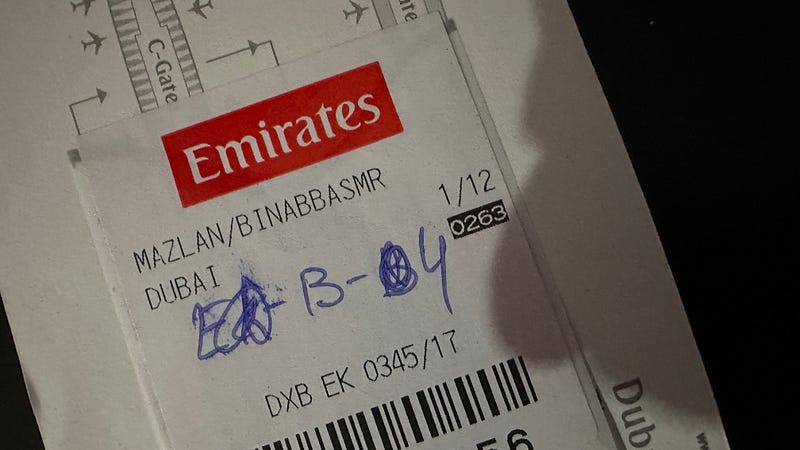
The secret to getting our baggage is to “Show the Boarding Pass with the Belt Number with Passport” to Security.
Then we heard someone get their bags by entering the baggage area. Since we had enquired and had our boarding pass written where the bags would be left, we entered the baggage area where passengers exited. But we needed to show the security our boarding passes and passports to enter that area.
Within several minutes, we managed to identify our bags!
Happy faces when we collected our bags within minutes by ourselves!
Once in a while, we heard people clapping and cheering — probably everyone managed to get their bags back.
This made us wonder why the airport officials couldn’t give very clear instructions on where and how to get our baggage in the first place. Many passengers get frustrated because they lack communication.
When the baggage system was disrupted due to floods, Dubai Airport could not cope with the impact. They should have given clear instructions to the passengers and changed their security policy so that passengers could collect their baggage by themselves. I think they did this very late, and many didn’t know the instructions, making all passengers queue again.
By 1 a.m., we had our bags and returned to our hotel, reaching 2 a.m. feeling very tired but satisfied because we would be flying back to Kuala Lumpur at 9.15 pm.
Luckily, the return flight was not delayed, and we returned home safely.







































 Dr. Mazlan Abbas